

In this article
- 01What exactly was approved
- 02Why “conditional and time-limited”
- 03Approval, market launch, and insurance coverage are three different things
- 04This does not mean all stem cell treatments are mature
- 05Parkinson’s disease: clinical progress does not equal routine treatment
- 06What this means if you are considering a consultation in Japan
- 07Common questions
Short answer
In March 2026, Japan’s Ministry of Health, Labour and Welfare (MHLW) granted “conditional and time-limited approval” to two iPS cell-derived regenerative medicine products, targeting severe heart failure and Parkinson’s disease. This shows that iPS research in Japan is entering formal product review and clinical use, but the approval has conditions and a time limit, and effectiveness data must continue to be collected; it also does not mean other stem cell treatments, other diseases, or clinics’ self-pay treatments are thereby “approved.”
- Timeline
- March 2026 (explained at the Minister of Health, Labour and Welfare’s March 6 press conference)
- Scope
- Two iPS cell-derived regenerative medicine products: severe heart failure, Parkinson’s disease
- Approval pathway
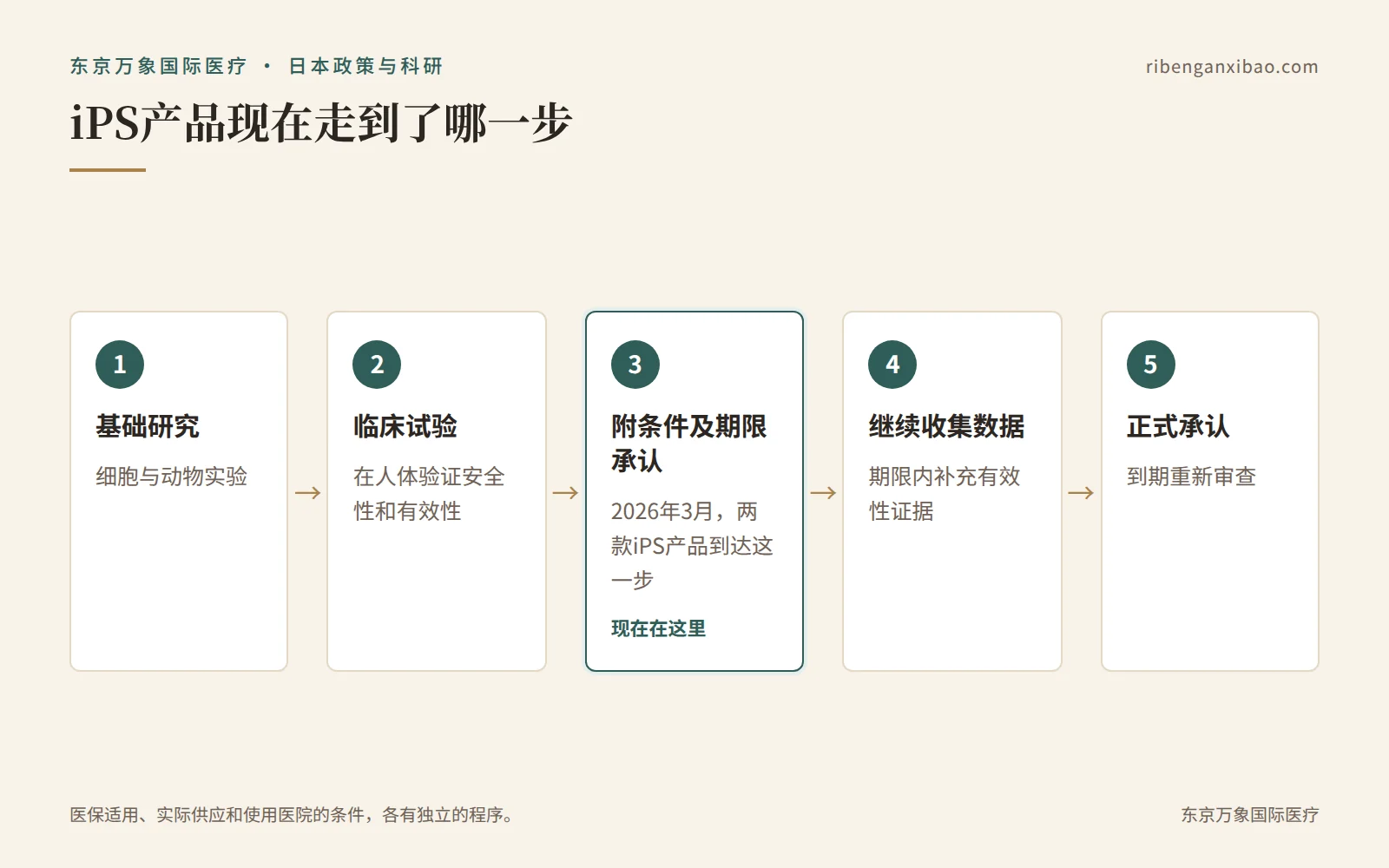
- Conditional and time-limited approval: safety confirmed, effectiveness presumed; data must continue to be submitted within the term and re-evaluated at expiry
- How it is used
- Used for the approved indications and conditions, at medical institutions that meet the requirements
- Relation to clinic self-pay treatments
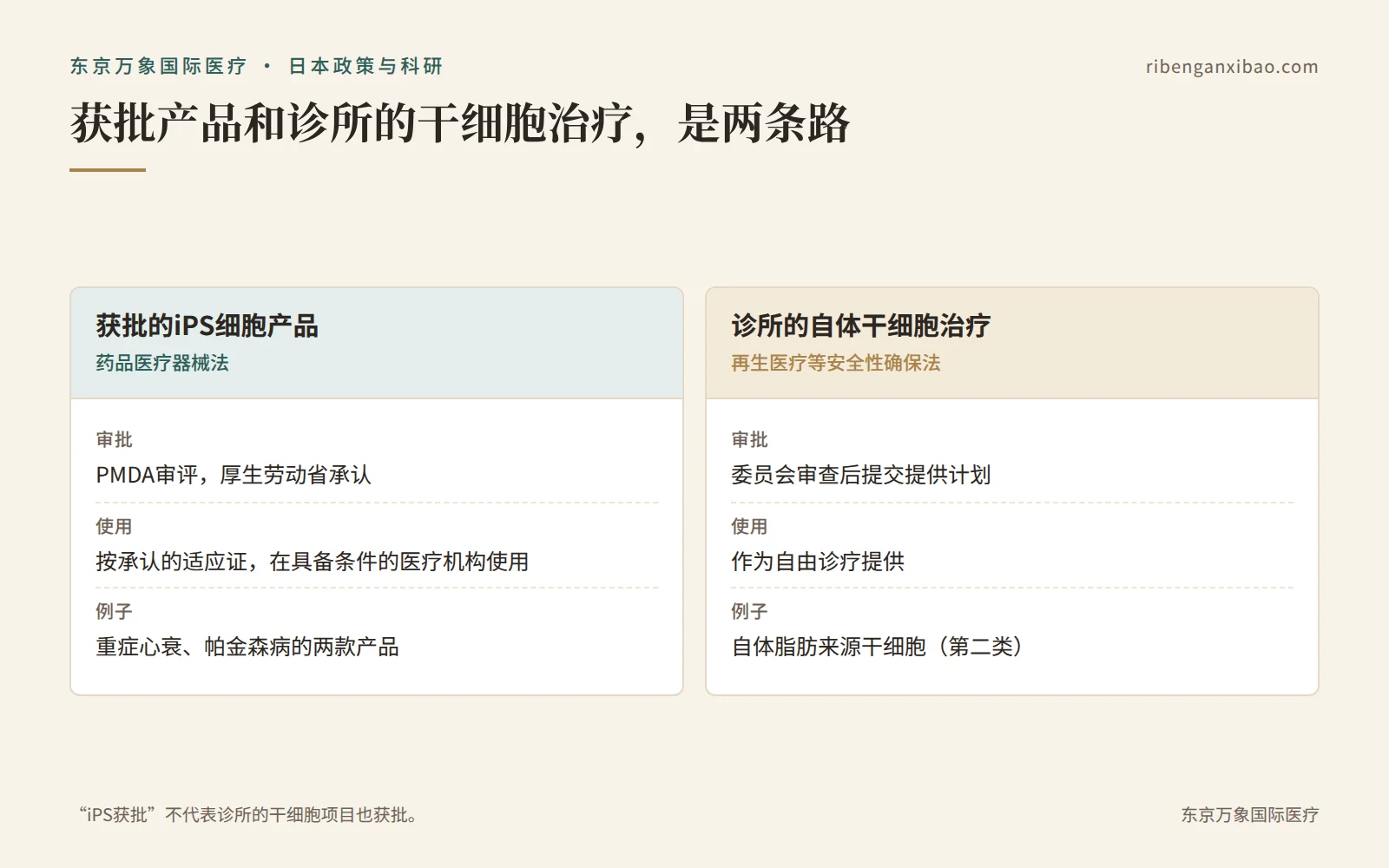
- No direct relation; clinics’ autologous stem cell treatments follow the regenerative medicine provision plan pathway
01
What exactly was approved
Both products are manufactured starting from iPS cells: one for severe heart failure and one for Parkinson’s disease. From Shinya Yamanaka’s team establishing iPS cells and his 2012 Nobel Prize to products completing approval today, Japan has invested over a decade in this route.
In the past, when discussing regenerative medicine in Japan, people often said “the research is strong, but there’s still a layer between it and patients.” This is effectively the first time the iPS route has connected “research—approval—clinical use.”
02
Why “conditional and time-limited”
This is an approval method designed specifically for regenerative medicine products in Japan: when safety is confirmed to a certain extent and effectiveness can be reasonably presumed, approval is granted with conditions and a time limit; data must be supplemented during the term, and it is re-reviewed at expiry. It is not lowering standards, but balancing “patients cannot wait” with “evidence still needs to accumulate.” For details, see “What is Japan’s ‘conditional and time-limited approval’.”
03
Approval, market launch, and insurance coverage are three different things
Product approval is only the first step. Next come actual supply, public health insurance applicability and pricing, and conditions for hospitals that can use it—each with its own procedures. When you see “approved” news, keep asking: exactly which product, for which indications, at which hospitals, under what conditions.
04
This does not mean all stem cell treatments are mature
Regenerative medicine is a large field; iPS approvals only show that one route and two specific indications have reached this step. When reading related news, remember these “does not equal” points:
- Research findings ≠ clinical products
- Clinical trials ≠ widespread clinical practice
- Product approval ≠ mature options for all indications
- iPS product approval ≠ approval of clinic stem cell treatments
05
Parkinson’s disease: clinical progress does not equal routine treatment
Cell therapy for Parkinson’s disease must still be understood in terms of stage of research, administration method (requires surgical transplantation), safety monitoring, and eligible populations; it cannot be summarized as “no surgery” or “cure.” Existing standard treatments (medications, deep brain stimulation, etc.) remain the foundation.
06
What this means if you are considering a consultation in Japan
These two products are used by qualified medical institutions for the approved indications; they are not self-pay treatments you can book at ordinary clinics. If someone recommends a clinic treatment on the grounds that “iPS is approved,” first ask: what cells does this treatment use, under which class of provision plan is it registered, and what does it have to do with the approved products?
07
Common questions
Can ordinary patients use these two iPS products?
They are used for the approved indications and conditions at medical institutions that meet the requirements. Whether foreign patients can use them and how to arrange it must be confirmed with the relevant medical institutions; you cannot book them through ordinary clinics.
Do clinic stem cell treatments also count as “approved”?
No. Clinics’ autologous stem cell treatments are self-pay treatments provided after a regenerative medicine provision plan has been submitted under the Act on the Safety of Regenerative Medicine—a different pathway from product approval under the Pharmaceuticals and Medical Devices Act.
Can Parkinson’s disease now be cured with stem cells?
It should not be understood that way. The approved products have specific eligibility conditions and still require ongoing collection of effectiveness data; standard treatments remain the foundation.