

In this article
Short answer
In Japan, before a medical institution provides regenerative medicine, it must submit a “regenerative medicine provision plan” according to risk class and can start only after review by a certified committee. You can ask the institution for the treatment name and plan number, then verify the institution name, person in charge, treatment name, and review committee in the MHLW e-Regenerative Medicine public lists. Registration shows it has entered legal oversight; it does not mean the government recognizes efficacy.
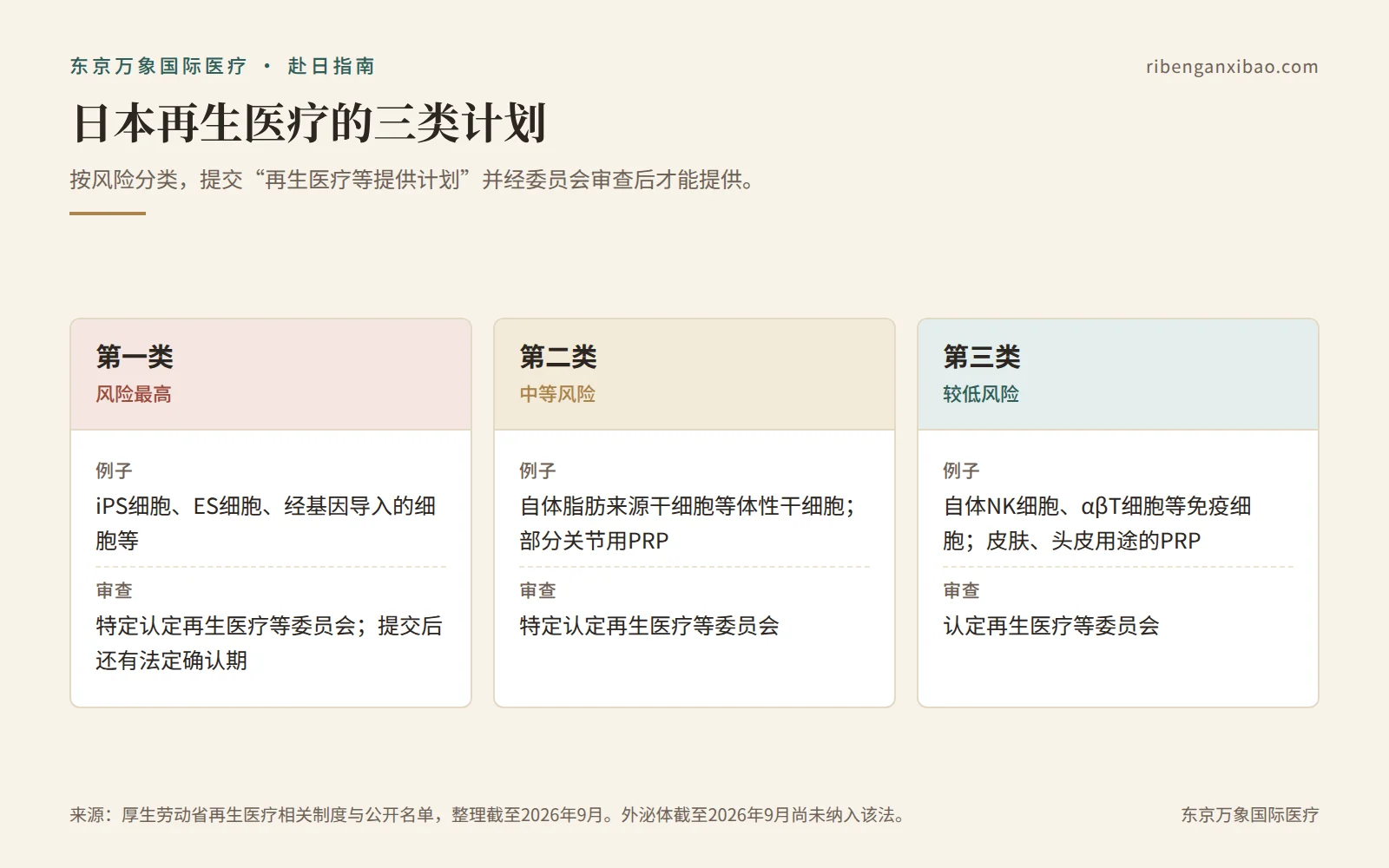
- Class I (highest risk)
- Examples include iPS cells, ES cells, and gene-introduced cells; reviewed by a Specially Certified Committee for Regenerative Medicine; after submission there is also a statutory confirmation period.
- Class II
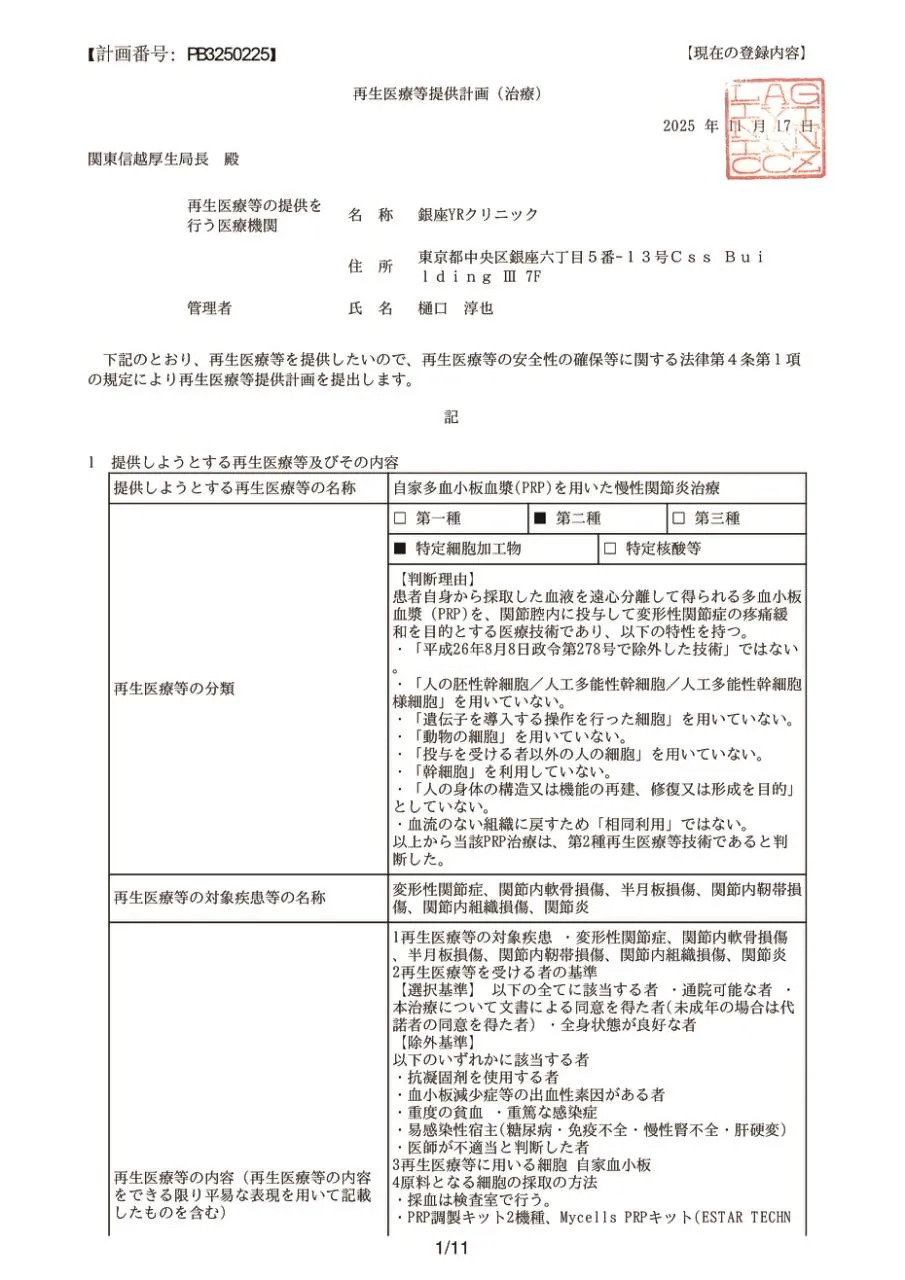
- Examples include autologous fat-derived stem cells and other somatic stem cells; some PRP for joints is also registered as Class II; reviewed by a Specially Certified Committee for Regenerative Medicine.
- Class III
- Examples include autologous NK cells, alpha-beta T cells and other immune cells, and PRP for skin/scalp uses; reviewed by a Certified Committee for Regenerative Medicine.
- Cell processing
- In-house cell processing facilities file a notification with the regional bureau of health and welfare; external processing companies must obtain a license.
- Providing without completing the procedures
- Illegal and punishable
- Exosomes
- As of September 2026, not yet covered by this Act; the MHLW is discussing regulation.
01
Why check the registration first
The MHLW states it plainly: providing regenerative medicine or manufacturing specified cell-processed products without the required procedures is illegal and punishable. So “can it be done” in Japan is something you can verify within the system.
Institutions that truly operate in compliance are not afraid of checks. If you ask for the plan number and process, they can explain clearly; if an institution talks at length about effects, prices, and cases but is vague when you ask about the compliance pathway, think twice.
02
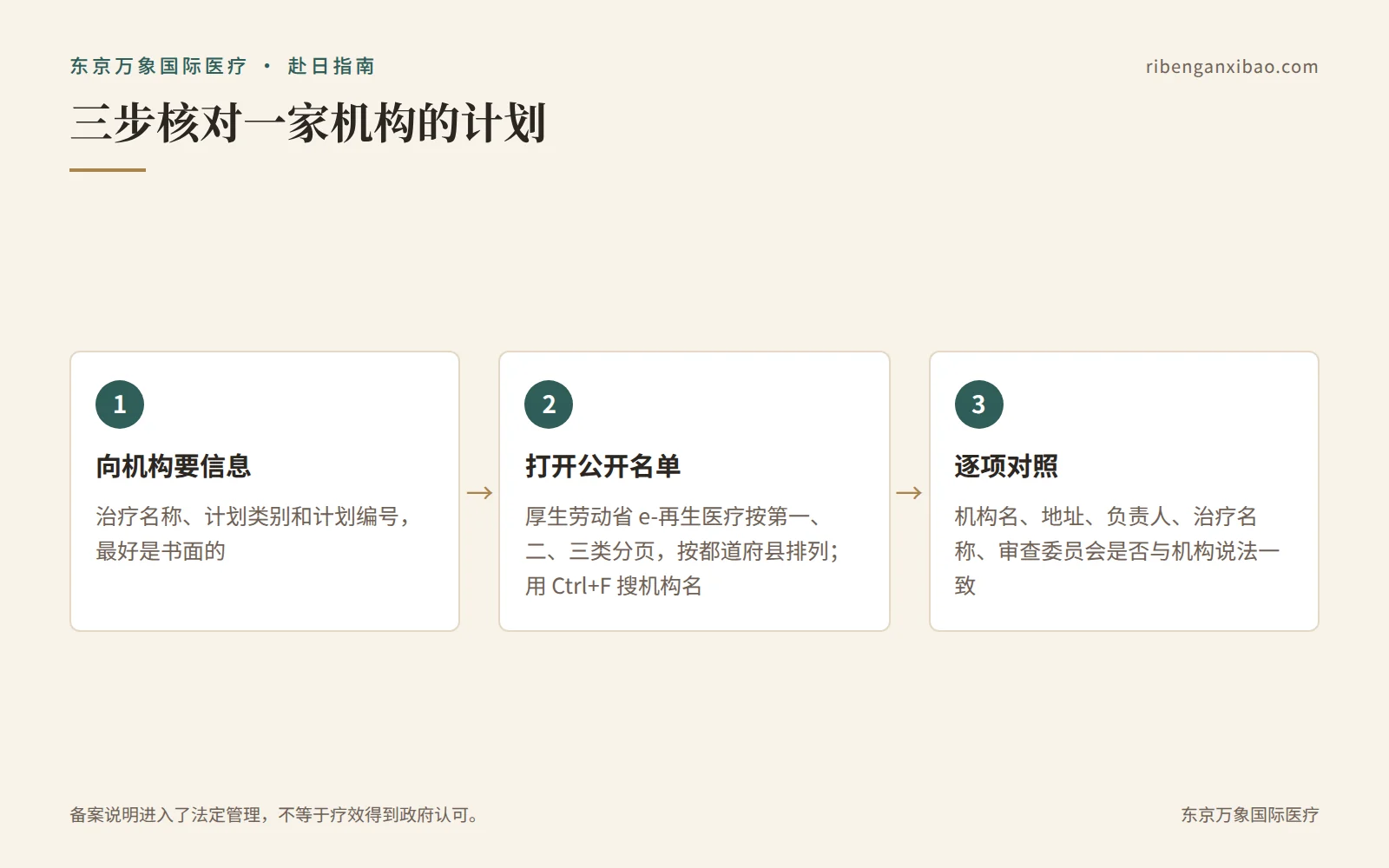
Three steps to verify an institution’s plan
You don’t need to read all the Japanese; follow these three steps to confirm the key facts:
- Step 1: Ask the institution for the treatment name, plan class, and plan number—preferably in writing.
- Step 2: Open the MHLW e-Regenerative Medicine public lists (separate pages for Class I, II, and III; arranged by prefecture) and use your browser’s find function (Ctrl+F) to enter the institution’s name.
- Step 3: Check whether the institution name, address, person in charge, treatment name, and review committee match what the institution told you.
03
Treatment or research: two different systems
Regenerative medicine provided as self-pay treatment has its plans submitted and published via “e-Regenerative Medicine”; those conducted as clinical research are registered and public on “jRCT” (Japan Registry of Clinical Trials).
The purposes and responsibilities differ: research has strict enrollment criteria, and costs and arrangements are not the same as self-pay treatment. When you inquire, ask directly: Is this treatment or research?
04
Registration is not an endorsement of efficacy
Submitting a provision plan and passing committee review means the treatment has entered a legal management track: there is review, periodic reporting, and record-keeping. It does not mean the government recognizes efficacy, nor that it suits everyone.
So checking the registration is a “first filter,” not the final answer. You still need to look at the doctor’s judgment, cell quality, and follow-up arrangements.
05
Also check the official updates
The MHLW’s regenerative medicine topic page has an “Updates” section listing notices, procedural requirements, and attachments by date. It’s not as readable as a brochure, but it tells you what’s being adjusted lately. Read it with three questions: Is this technological progress or a regulatory notice? Does it concern products, institutions, plans, or legal procedures? Is it expanding the scope, or reminding everyone of the limits?
06
Common questions
Does having a plan number mean the treatment works?
No. Registration means the institution submitted a plan per legal procedure and is subject to review and periodic reporting. Effectiveness still depends on specific evidence and the doctor’s judgment for your individual case.
If an institution says “the plan is under application,” can they start now?
No. Before submitting a provision plan, that regenerative medicine cannot be provided; for Class I you also need to wait until the statutory confirmation period ends.
Does PRP also require registration?
Yes. PRP falls under regenerative medicine, and institutions must submit a provision plan. The class may differ by use—for example, joint use versus skin/scalp use may fall under Class II and Class III respectively—subject to the institution’s published plan.
Do exosomes need registration?
Exosomes contain no cells, and as of September 2026 they are not yet covered by the Act on the Safety of Regenerative Medicine, so there is no provision plan to look up; the MHLW is discussing how to regulate them. When consulting, be sure to ask about source, preparation, and quality testing.
Read next
Sources
- MHLW: Systems and procedures related to the Act on the Safety of Regenerative Medicine
- MHLW e-Regenerative Medicine: Submitted Class I regenerative medicine provision plans
- MHLW e-Regenerative Medicine: Submitted Class II regenerative medicine provision plans
- MHLW e-Regenerative Medicine: Submitted Class III regenerative medicine provision plans