

In this article
Short answer
Cell storage means freezing and storing your own cells or tissues for possible future use. It is a long-term sample management service; it does not guarantee future treatment use, nor does it replace current diagnosis. Before signing, ask: what is stored, where it is kept, what standards are used for testing, how fees are calculated, how future retrieval or transfer works, and how things are handled if the institution ceases operations or you want to terminate.
- What it is
- Long-term sample management service, not treatment
- Common forms
- Cryopreserved cultured cells, or collected tissues such as fat
- Whether it can be used in the future
- Depends on the regulations, technology, cell condition, and your health status at that time
- Key contract terms
- Fees, term, retrieval, transfer, termination and destruction
- Fees
- The written contract prevails; note whether first-year and renewal fees are separate
01
What is being stored
First confirm the object of storage: are they already cultured cells, or collected but uncultured tissues? How many are there, and into how many portions are they stored? This determines what can be done later and what further steps are needed.
02
Whether stored cells can be used later depends on several conditions
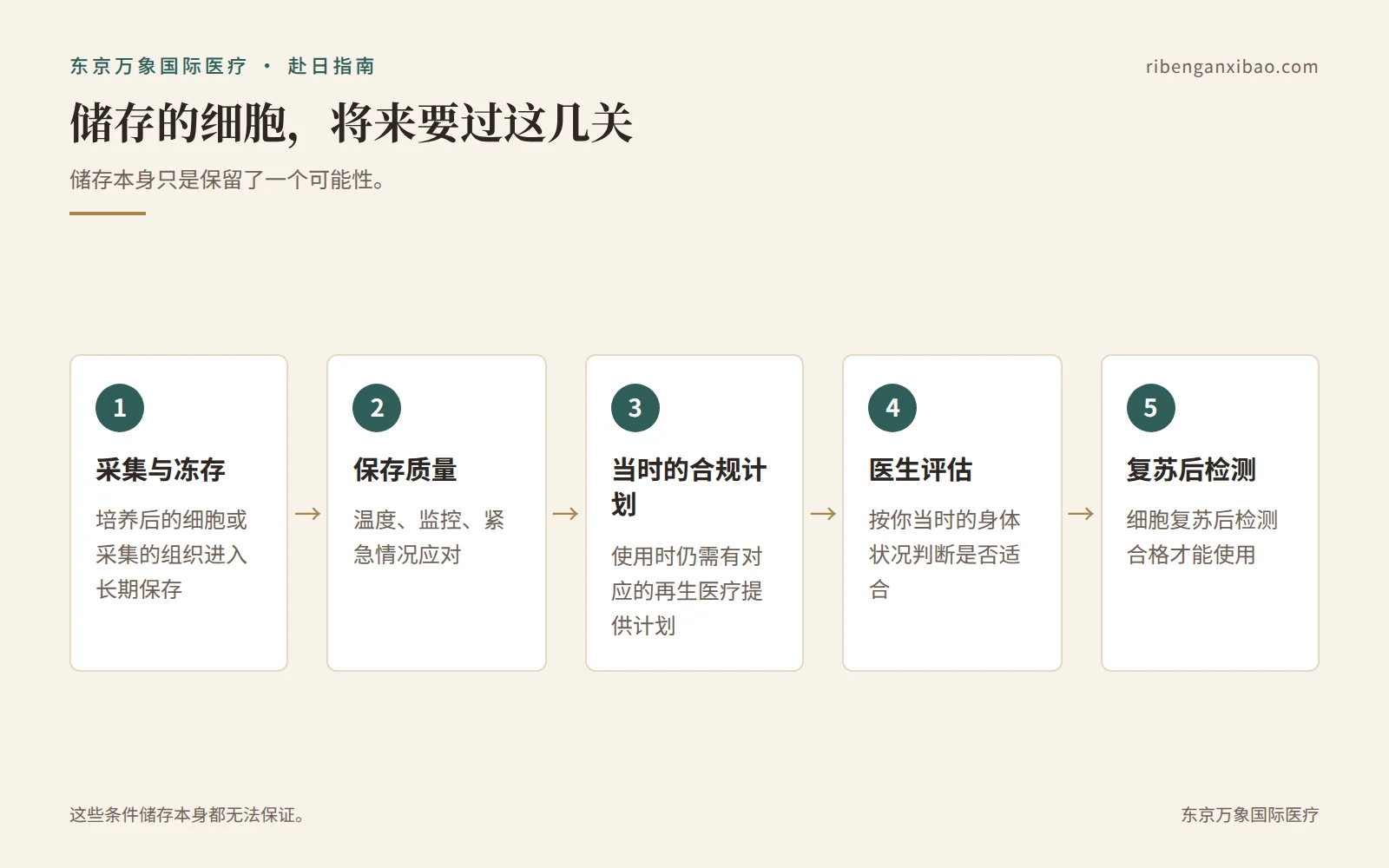
For stored cells to be used for treatment in the future, there must be a compliant regenerative medicine provision plan in place at that time, a physician must evaluate your then-current health status, and the cells must pass testing after thawing. Storage itself cannot guarantee these conditions will be met.
So do not treat cell storage as “insurance you can use anytime later”; it is more like keeping a possibility open.
03
Clauses to check in the contract
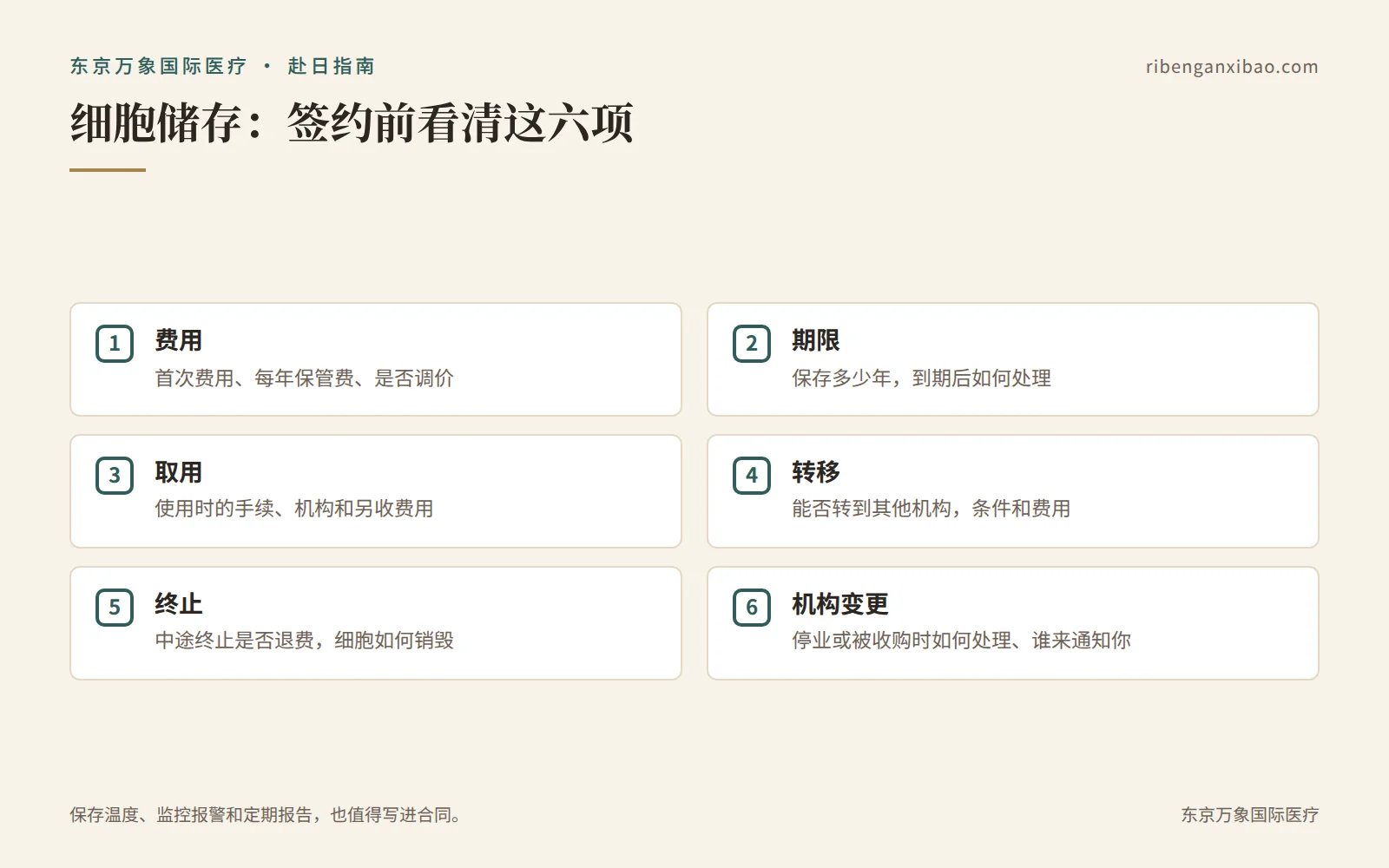
- Fees: initial fees, annual storage fees, renewal method, and whether prices may change
- Term: how many years of storage, and what happens at expiry
- Retrieval: what procedures are required for future use, which institutions can use them, and whether additional fees apply
- Transfer: whether they can be moved to another institution or facility, and the fees and conditions
- Termination: what happens if you want to terminate, whether paid fees are refundable, and how the cells will be destroyed
- Institutional changes: if the storage facility or institution closes or is acquired, how the cells will be handled and who will notify you
04
How to verify storage quality
Clarify storage temperature and equipment (e.g., liquid nitrogen tanks), temperature monitoring and alarm mechanisms, responses to power outages and other emergencies, and whether samples are stored separately to reduce risk. Whether you can receive periodic reports on storage status is also worth writing into the contract.
05
Common questions
Are stored cells guaranteed to be usable?
Not necessarily. Future use still requires a compliant treatment plan, physician evaluation, and post-thaw testing; storage itself cannot guarantee these conditions.
Can they be transferred to another institution?
It depends on the contract terms and the receiving party’s conditions. Specify the procedures, fees, and limits for transfer before signing.
What if the storage provider ceases operations?
The contract should state how to handle institutional changes or closure, including whether to transfer, who will notify you, and how costs are borne.
Do I need to come to Japan during the storage period?
Generally no. Collection is usually combined with a single trip to Japan; whether you need to visit the clinic at the time of use depends on the plan in place then.