

In this article
Short answer
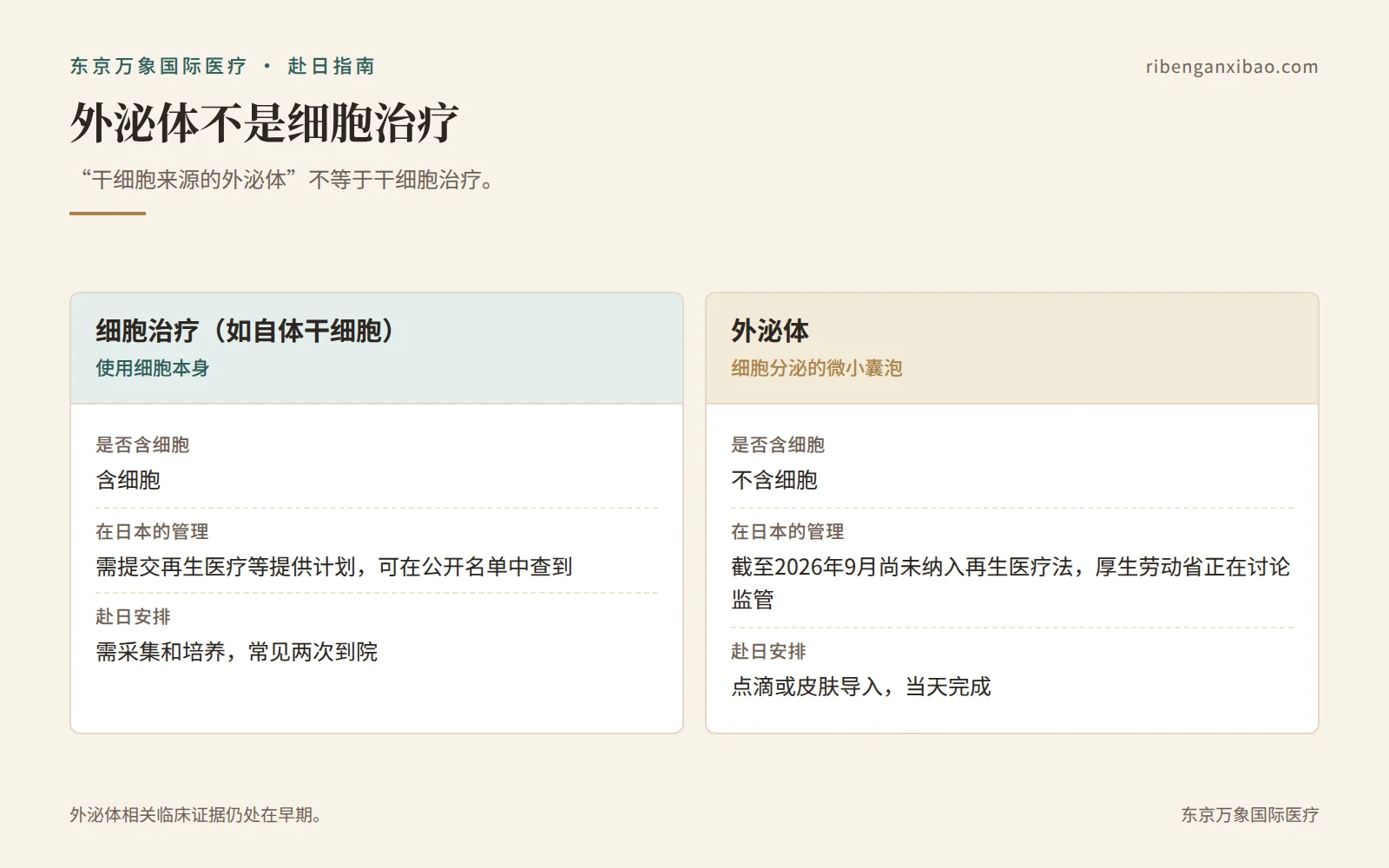
Exosomes are nanosized vesicles secreted by cells that carry proteins, nucleic acids, and other substances; they do not contain cells. In Japan, exosome IV drips or skin delivery are self-pay, and as of September 2026 they are not yet covered by the Act on the Safety of Regenerative Medicine, so there are no provision plans to look up. The Ministry of Health, Labour and Welfare (MHLW) is discussing regulation. Clinical evidence remains early; ask carefully about source, manufacturing process, quality testing, and dosing/administration.
- What it is
- Tiny vesicles secreted by cells, do not contain cells
- Common sources
- Derived from iPS cells, umbilical cord mesenchymal stem cells (MSCs), fat-derived stem cells, etc.
- How it’s used
- IV drip, or introduced into the skin with mesotherapy and similar methods
- Regulation in Japan
- Not yet covered by the Act on the Safety of Regenerative Medicine; no provision plans to look up. The MHLW is discussing regulation.
- Evidence status
- Mainly basic research and early clinical studies
- Timing
- Same day; can be scheduled alongside other activities
01
What are exosomes
Cells release various tiny vesicles; exosomes are one type. They are thought to participate in intercellular communication and are one of the hot topics in regenerative medicine research.
It is important to be clear that “stem cell-derived exosomes” are not the same as stem cell therapy. They do not contain cells, and their mechanisms, evidence, and regulatory pathways differ from those of cell therapy.
02
iPS-derived vs umbilical cord-derived exosomes: what’s the difference
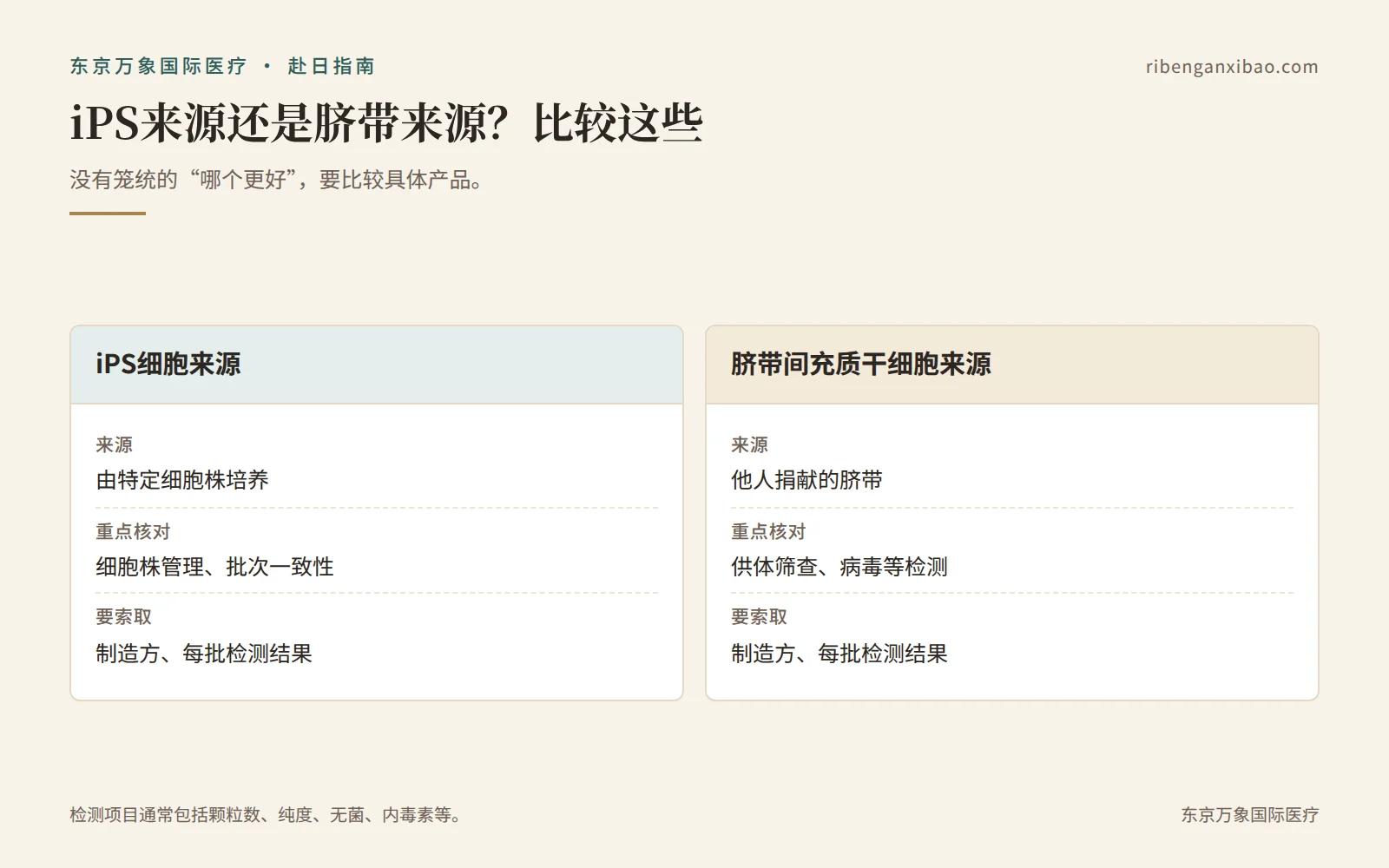
The key difference is the source cells: iPS cell-derived products are cultured from specific cell lines, so focus on cell line management and batch consistency; umbilical cord mesenchymal stem cell-derived products come from donated cords, so focus on donor screening and testing for viruses, etc.
There is no blanket “which is better.” What truly merits comparison is the specific product: who manufactures it, in what facility, to what testing standards, and whether batch results can be provided.
03
“No cells” does not mean “no regulation”
Exosomes are not currently within the scope of the Act on the Safety of Regenerative Medicine, but medical institutions using them must still follow the Medical Care Act and medical advertising rules. Their source, production, quality, and administration route should be clearly explained.
Precisely because there are no provision plans to look up, during consultation the institution should proactively provide product documentation, not just a label like “iPS” or “stem cell.”
04
Questions to ask during consultation
- What is the product name, and who manufactures it?
- What are the source cells, and how are the donor or cell line managed?
- What quality tests have been done (particle count, purity, sterility, endotoxin, etc.), and can written results be provided?
- What is the basis for the administration route and dosage?
- What adverse reactions may occur (e.g., fever, allergy), and how are they handled?
- Why is it suitable for me, and what metrics will be used to assess it?
05
How to fit it into your plan
A better positioning is as a supplementary option for health management or skin care, not as a means to treat a disease. People with allergies, autoimmune diseases, or a history of cancer should have a doctor evaluate first before deciding.
06
Common questions
Are exosomes safer than stem cells?
You can’t compare them simply. Exosomes don’t contain cells, but source, manufacturing, and quality vary greatly, and long-term safety data are still limited.
Are there registration records for exosomes that can be looked up?
As of September 2026, no. They are not yet covered by the Act on the Safety of Regenerative Medicine, so there is no provision plan number. This makes it even more important to ask clearly about the manufacturer and testing documentation.
Can exosomes treat diseases?
Currently in Japan there are no exosome formulations approved to treat specific diseases, and related clinical research is still in early stages. Institutions’ explanations should not use promise-like terms such as “treat” or “repair.”
Can it be done in a single trip?
Yes. Exosome IV drips or skin delivery can be done the same day and can be arranged together with other activities.