

In this article
Short answer
When you hear “policy window period, about to be banned,” “exclusive technology, cannot be replicated,” “luxury experience, one-stop package,” pause and check three things: is there an official document you can verify, is there data that can be provided in writing, and did the doctor explain indications, risks, and alternatives. In Japan, medical advertising rules prohibit false or exaggerated claims, comparisons of superiority with other institutions, and using patient testimonials to promote treatment effects.
- Japan’s medical advertising bans
- False or exaggerated claims, comparisons of superiority with other institutions, patient treatment testimonials, and before-and-after photos lacking necessary explanations
- “Policy window period”
- Ask them to provide an official announcement or document and verify the content and dates
- “Exclusive technology”
- Ask for written data and the corresponding registration information
- “Premium experience”
- Service can matter, but the core of a medical decision is indications, evidence, and risks
01
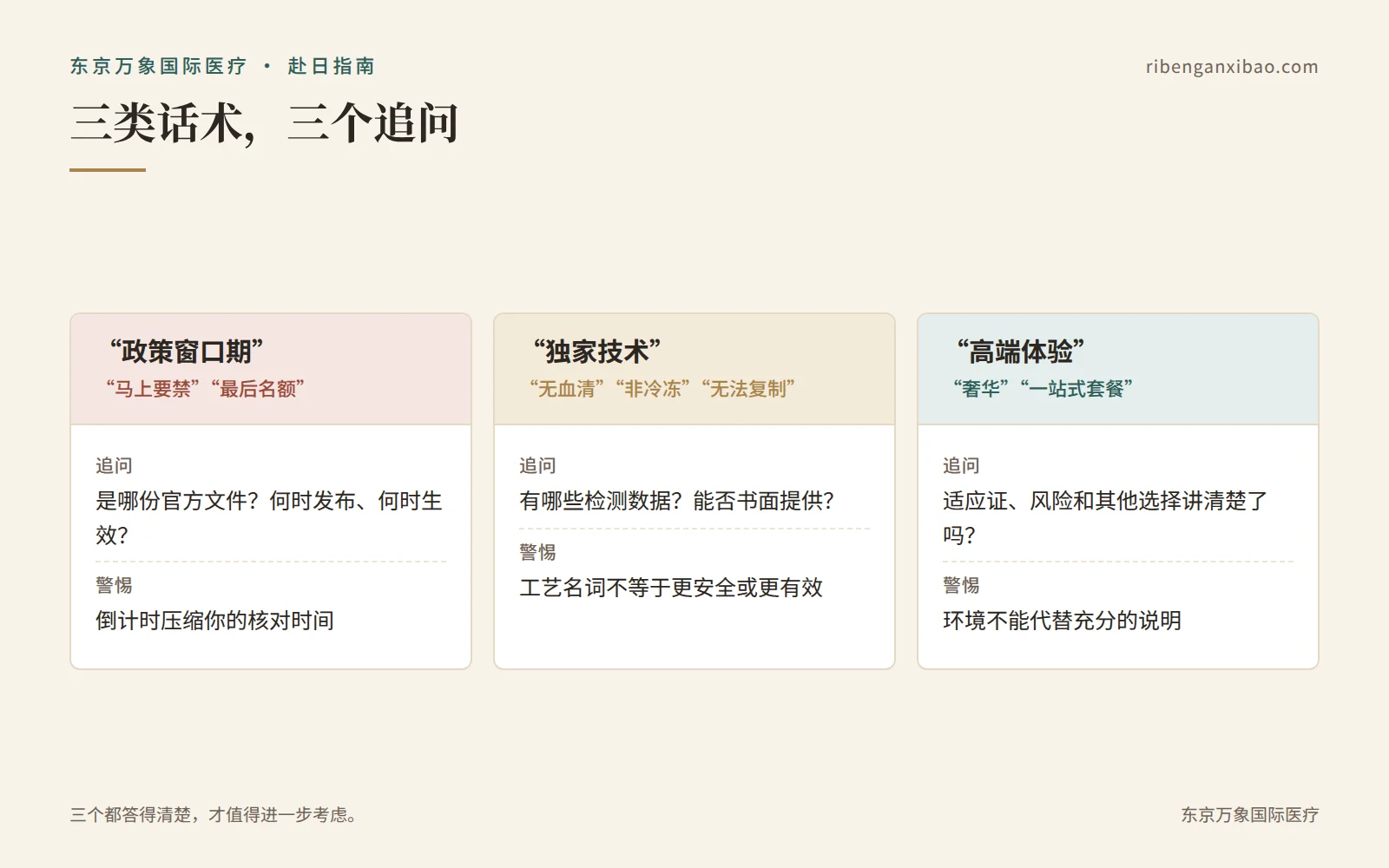
“Policy window period,” “last chance”
Regulations do change, but countdowns like “closing soon,” “only a few spots left,” “price goes up after this month” compress your time to think and verify.
You can ask directly: Which official document? When was it issued and when does it take effect? What specific impact does it have on the treatment I’m considering? If they can’t answer, it’s basically marketing talk.
02
“Serum-free,” “non-frozen,” “proprietary process”
The culture medium and storage method do affect the process, but these technical terms cannot be equated directly with “safer” or “more effective” without the specific cells, validation data, and clinical context.
Worth asking: What testing data are there for this process? Compared with other methods, on which measurable indicators do the differences appear? Can these data be provided in writing?
03
“This is a premium experience, not medical care”
Environment and service can matter, especially for those traveling far. But regenerative medicine is not a beauty package; a luxurious setting cannot replace thorough explanations on suitability, evidence, risks, and alternatives.
04
What Japan’s medical advertising rules prohibit
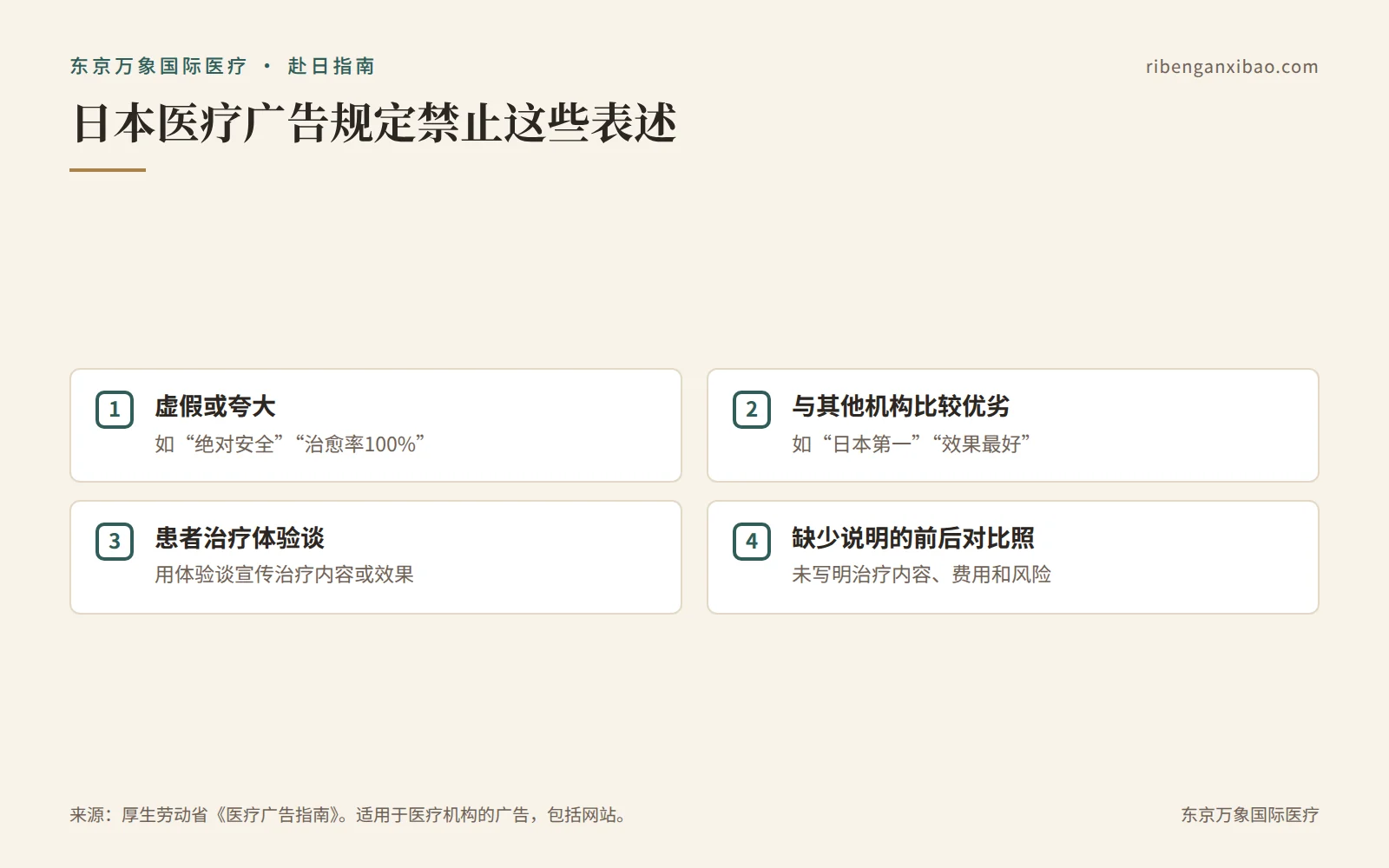
The Ministry of Health, Labour and Welfare (MHLW)’s medical advertising regulations and guidelines prohibit medical institutions from including the following in advertisements (including websites):
- False or exaggerated content (e.g., “absolutely safe,” “100% cure rate”)
- Comparisons of superiority with other medical institutions (e.g., “No. 1 in Japan,” “best results”)
- Using patient treatment testimonials to promote the content or effects of treatment
- Before-and-after photos that lack explanations of treatment content, costs, risks, etc.
05
A simple way to judge
For any claim, try asking three questions: Is there an official document? Is there written data? What does the doctor personally say? Only when all three are answered clearly is it worth further consideration.
06
Common questions
Is it credible when an institution says “The rules are changing; if you don’t do it now, you’ll miss the chance”?
First ask them to provide the official document and verify the content and effective date. Even if the rules are really changing, medical decisions should be based on your situation and full explanations, not a countdown.
Are “serum-free culture” and “non-frozen cells” necessarily safer?
Not automatically. These are process choices; whether they make a difference depends on specific testing data and clinical evidence.
Can others’ positive reviews and cases be a reference?
Service experience can be a reference, but an individual’s treatment experience does not represent your situation; in Japan, using patient testimonials to promote treatment effects is itself prohibited by the medical advertising rules.