In this article
Short answer
Ginza YR Clinic currently has 9 regenerative medicine provision plans submitted to the Ministry of Health, Labour and Welfare. Five Class II: autologous fat-derived stem cells for intra-articular injection for joints (PB3250224), intravenous injection for pain (PB3250226), skin regeneration (PB3250279), hair regeneration (PB3250305), and joint PRP (PB3250225). Four Class III: PRP for hair (PC3250242), PRP for skin (PC3250241), NK cells (PC3250228), alpha-beta T cells (PC3250227). The in-house cell processing center also has a notification for manufacturing specified cell-processed products (FC3250098). These plans can be cross-checked on the MHLW public list and the clinic website. Registration means the treatment falls under statutory oversight; it does not mean the government has recognized its efficacy.
- Total number of plans
- 9 items: five Class II, four Class III; no Class I plans
- Autologous stem cells (Class II)
- Four items for intra-articular injection for joints, intravenous injection for pain, skin regeneration, and hair regeneration, all using the patient’s own fat-derived mesenchymal stem cells (MSCs)
- PRP
- Joint use is Class II (PB3250225); skin and hair uses are Class III (PC3250241, PC3250242)
- Immune cells (Class III)
- NK cells (PC3250228), alpha-beta T cells (PC3250227)
- Cell processing
- In-house cell processing center (CPC), notification for manufacturing specified cell-processed products FC3250098
- Submission authority
- Kanto-Shinetsu Regional Bureau of Health and Welfare (plan documents addressed to “Director, Kanto-Shinetsu Regional Bureau of Health and Welfare”)
- Manager
- Dr. Junya Higuchi (Clinic Director)
01
Overview of the 9 plans
Compiled from the clinic website and plan documents. The English names are our translations; the Japanese originals prevail.
| Plan number | Category | Content | Source |
|---|---|---|---|
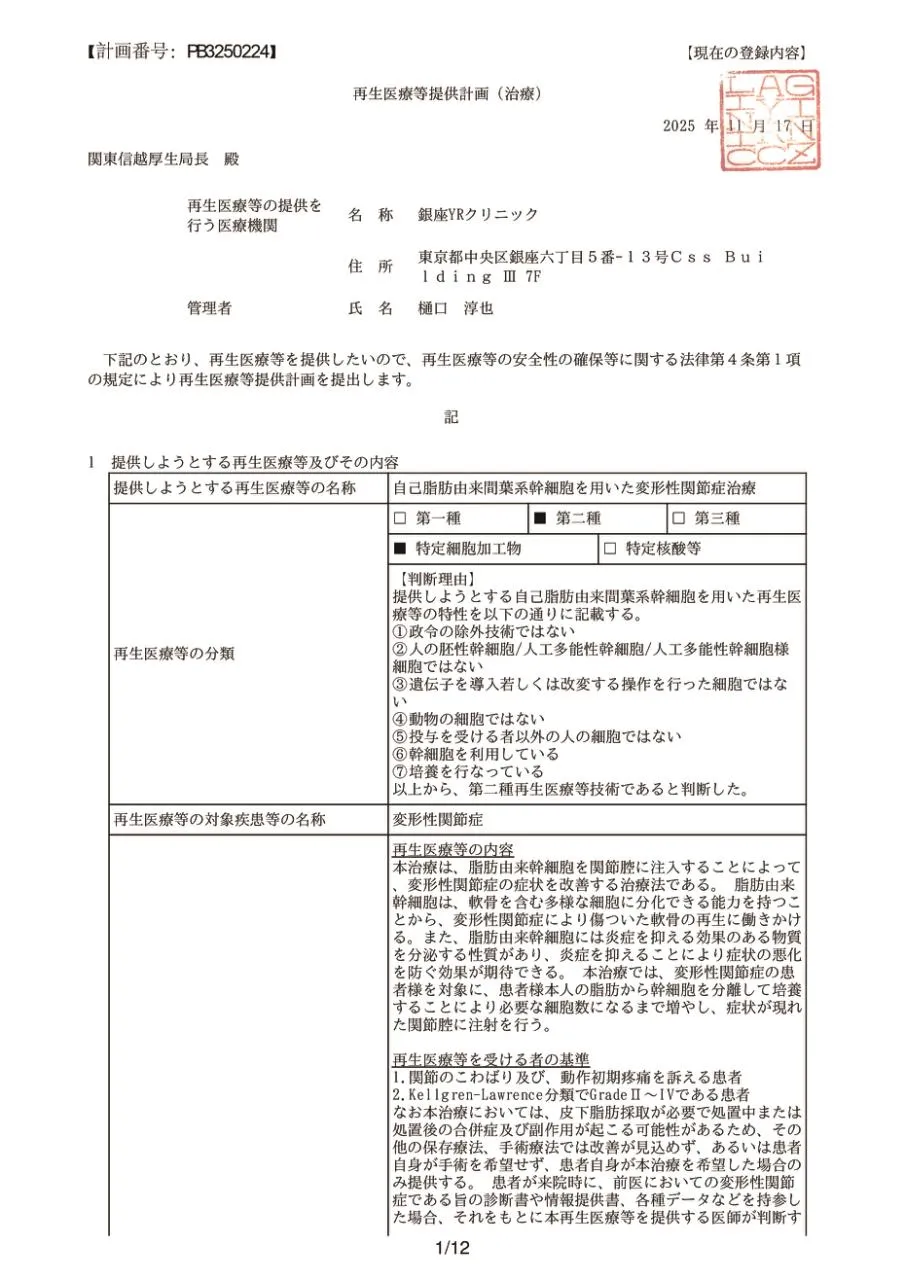
| PB3250224 | Class II | Autologous fat-derived mesenchymal stem cells: treatment of joint disease (intra-articular injection) | Patient’s own fat |
| PB3250226 | Class II | Autologous fat-derived mesenchymal stem cells: intravenous injection for pain | Patient’s own fat |
| PB3250279 | Class II | Autologous adipose tissue-derived mesenchymal stem cells: skin regeneration | Patient’s own fat |
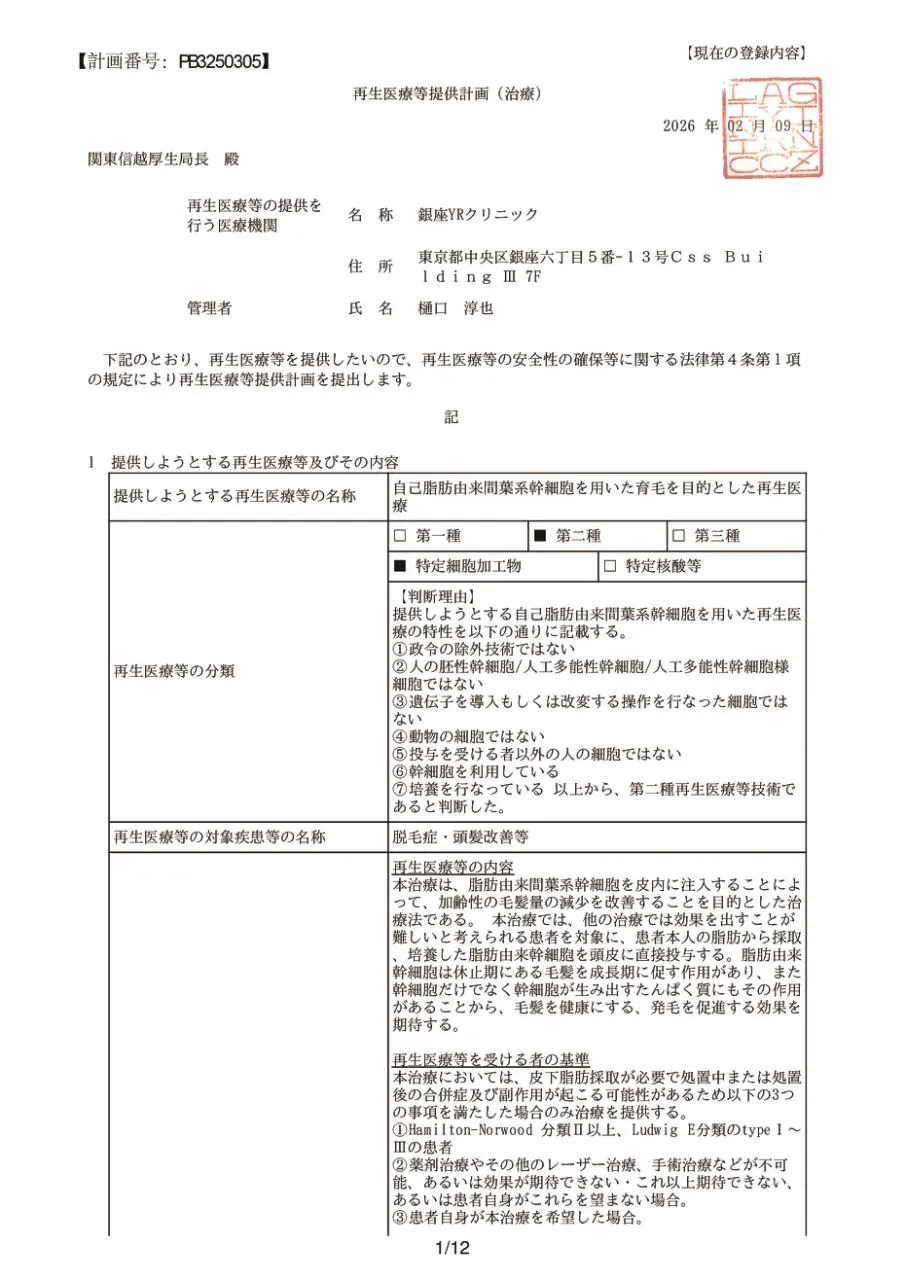
| PB3250305 | Class II | Autologous fat-derived mesenchymal stem cells: hair regeneration | Patient’s own fat |
| PB3250225 | Class II | PRP (platelet-rich plasma): treatment of chronic arthritis | Patient’s own blood |
| PC3250242 | Class III | PRP: hair regeneration | Patient’s own blood |
| PC3250241 | Class III | PRP: skin regeneration | Patient’s own blood |
| PC3250228 | Class III | NK cells: cancer immunotherapy | Patient’s own blood |
| PC3250227 | Class III | alpha-beta T cells: cancer immunotherapy | Patient’s own blood |
| FC3250098 | Cell processing facility | Notification for manufacturing specified cell-processed products for the in-house cell processing center | — |
02
How to read the numbers
The letters at the start indicate the category: PB = Class II regenerative medicine provision plan, PC = Class III, FC = manufacturing notification for a cell processing facility. So just from the code, you can tell whether it is Class II or Class III.
PRP for joints is Class II, while PRP for skin and hair is Class III. This classification is by use and risk; it is not chosen by the clinic. Ginza YR has no Class I plans: its cell therapies all use the patient’s own cells, without using donor cells, iPS cells, or gene-modified cells.
The NK cell and alpha-beta T cell plans are named “cancer immunotherapy,” but they are self-pay supplementary options and cannot replace standard treatments such as surgery, chemotherapy, or radiotherapy. Suitability should be judged jointly by your attending physician and the Japanese physician.
03
Verify it yourself in three steps
You don’t need to read all the Japanese. Follow the three steps below to confirm the key facts:
- Step 1: Open the clinic website; the LICENSE section lists each plan number and treatment name.
- Step 2: Open the MHLW e-Regenerative Medicine public lists (Class II and Class III tabs). Use your browser’s page search (Ctrl+F) and enter “YR” to find the clinic.
- Step 3: Check that the institution name (in Japanese, “銀座YRクリニック”), the address (“中央区銀座6-5-13”, i.e. 6-5-13 Ginza, Chuo-ku), the manager (“樋口淳也”, Dr. Junya Higuchi), and the treatment names match the clinic and this page.
04
Treatments not covered by registration
Ginza YR also offers iPS cell exosome infusions, umbilical cord-derived exosome (secretome) infusions, NAD⁺ β-NMN infusions, and aesthetic medicine services. These are not regenerative medicine regulated by the Act on the Safety of Regenerative Medicine, so there are no provision plan numbers: exosomes and secretome do not contain cells and, as of October 2026, have not been brought under this Act; NAD⁺ infusions are ordinary self-pay IV drips.
When inquiring about these, ask about product source, manufacturer, quality testing, and dosage, rather than a registration number.
05
What registration does and does not indicate
Submitting a regenerative medicine plan means the treatment has been reviewed by a Certified Committee for Regenerative Medicine, with subsequent periodic reporting, record retention, and required adverse event reporting. It indicates “under legal management,” not “efficacy recognized.”
So registration is the first screen. Whether it suits you, which item to do, and how many times must still be decided after a doctor reviews your medical history and tests. We have a cooperative relationship with Ginza YR Clinic; see About us.
06
Common questions
Are Ginza YR Clinic’s registrations real? How do I check?
You can check yourself. The LICENSE section of the clinic website lists the numbers and treatment names; then go to the MHLW e-Regenerative Medicine public lists for Class II and Class III, use page search to enter “YR,” and verify the institution name, address, manager, and treatment names.
Does Ginza YR have umbilical cord-derived stem cell therapy?
No. All nine Ginza YR plans are Class II and Class III, and the cell therapies use the patient’s own cells. Its umbilical cord-related offering is exosome (secretome) infusions, which contain no cells and are not within the Act’s registration scope.
Why is some PRP Class II and some Class III?
Japan classifies by use and risk: Ginza YR’s PRP for joints is submitted as Class II, while PRP for skin and hair is submitted as Class III.
Why don’t exosome infusions have registration numbers?
Exosomes do not contain cells and, as of October 2026, have not been included under the Act on the Safety of Regenerative Medicine, so there is no provision plan to submit. When consulting, you should ask clearly about product source, manufacturing, and quality testing.
Can the registered content change?
Yes. Plans can be changed or discontinued. Rely on the latest information on the MHLW lists and the clinic website. This page notes the update date.
Read next
Sources
- Ginza YR Clinic official website (address, clinic hours, registration numbers)
- MHLW e-Regenerative Medicine: submitted Class II regenerative medicine provision plans
- MHLW e-Regenerative Medicine: submitted Class III regenerative medicine provision plans
- MHLW: systems and procedures related to the Act on the Safety of Regenerative Medicine