

In this article
- 01What is the Visa for Medical Stay?
- 02In what situations should you look into the Visa for Medical Stay?
- 03How long can you stay?
- 04What steps are usually needed before applying?
- 05What should you check when choosing a coordination service?
- 06Documents to prepare before traveling to Japan
- 07References
- 08Common questions
Short answer
If you are visiting Japan to receive medical care, you can apply for a “Visa for Medical Stay.” It applies to treatment, comprehensive checkups, and medical examinations, and accompanying persons may also apply when truly necessary. The typical process is to first contact a Japanese medical institution through a registered guarantor organization and have it confirm acceptance, then apply at a Japanese embassy or consulate with documents from the medical institution and the guarantor organization. Lengths of stay include 90 days, 6 months, and 1 year, subject to the review result.
- Scope
- Treatment, comprehensive checkups, medical examinations, dental care, and some recuperation services
- Length of stay
- 90 days, 6 months, or 1 year, depending on individual circumstances
- Multiple-entry visa
- Each stay generally does not exceed 90 days, with materials such as a treatment plan prepared by a Japanese doctor required
- Application process
- Contact a guarantor organization → medical institution confirms acceptance → prepare documents → apply to a Japanese embassy or consulate
- Accompanying persons
- May also apply when truly necessary
01
What is the Visa for Medical Stay?
Japan has a “Visa for Medical Stay” for foreign patients who travel to Japan to receive medical services. According to the Ministry of Foreign Affairs of Japan’s public guidance, its scope includes not only treatment but also comprehensive checkups, medical examinations, dental care, and some recuperation services arranged by Japanese medical institutions. When truly necessary, accompanying persons may also apply.
A visa addresses entry and stay arrangements; it is not the same as permission for treatment and does not mean a given service is necessarily suitable for the applicant. Whether you can be accepted, and what tests and documents are required, is determined by the medical institution based on the actual situation.
02
In what situations should you look into the Visa for Medical Stay?
Whether you need to apply for a Visa for Medical Stay depends on your purpose of care, expected length of stay, whether multiple trips to Japan are needed, and the intake requirements of the medical institution.
Common situations include: needing a Japanese medical institution to confirm acceptance and treatment arrangements in advance; needing family or other companions; expecting a longer stay in Japan; a treatment plan requiring multiple trips within a period; or the medical institution requiring coordination through a registered guarantor organization.
03
How long can you stay?
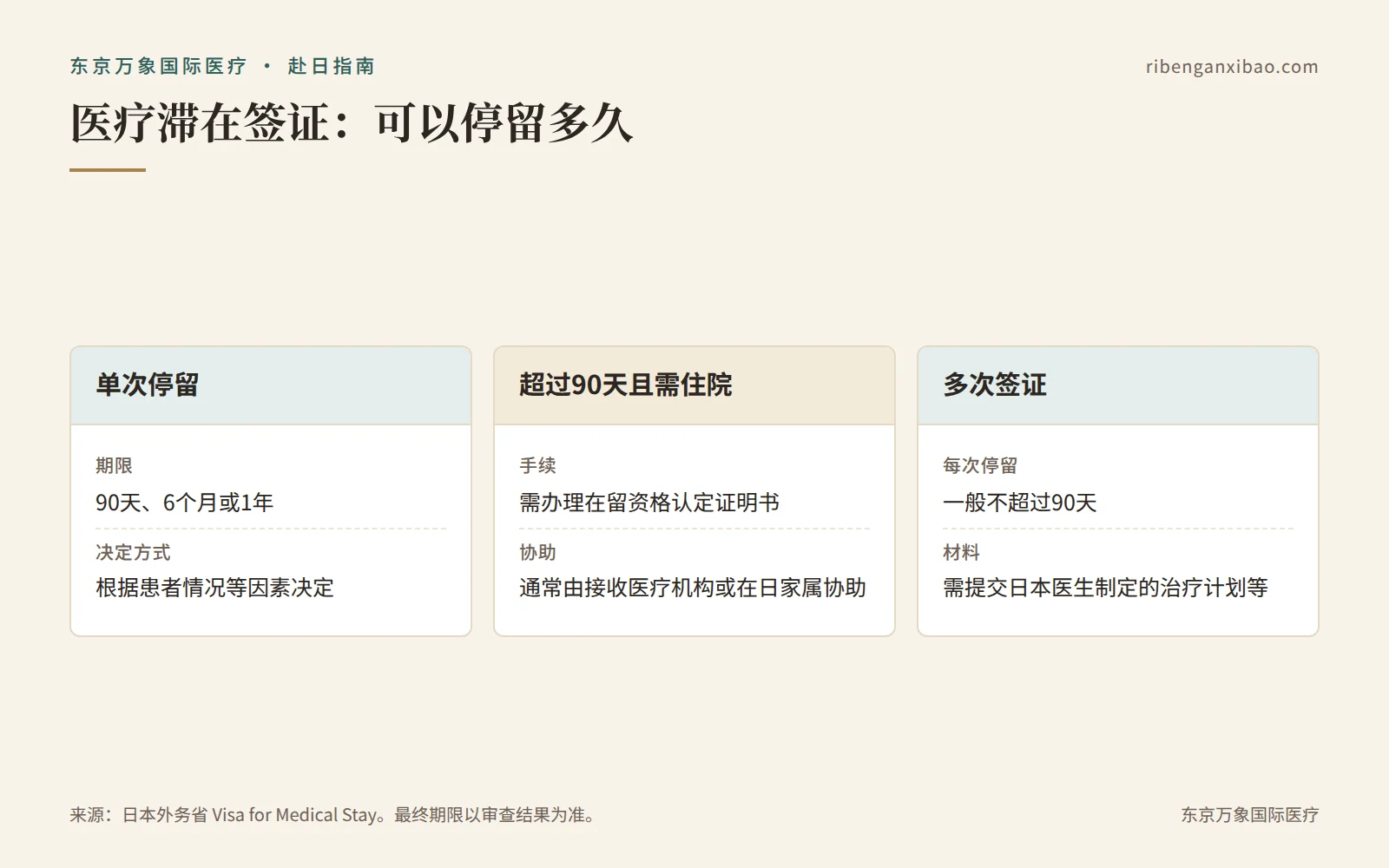
The Ministry of Foreign Affairs of Japan lists lengths of stay of 90 days, 6 months, or 1 year; the actual period is decided based on factors such as the patient’s situation.
If you expect to stay longer than 90 days and need to be hospitalized in a Japanese medical institution to receive medical services, you must also obtain a Certificate of Eligibility as required. These procedures are usually handled by staff of the receiving medical institution or by family members residing in Japan.
If multiple trips are needed, you may also apply for a multiple-entry visa. The Ministry of Foreign Affairs of Japan notes that multiple-entry visas generally require each stay not to exceed 90 days and submission of materials such as a treatment plan prepared by a Japanese doctor. The final period and issuance result are subject to review by Japanese embassies or consulates and the relevant authorities.
04
What steps are usually needed before applying?
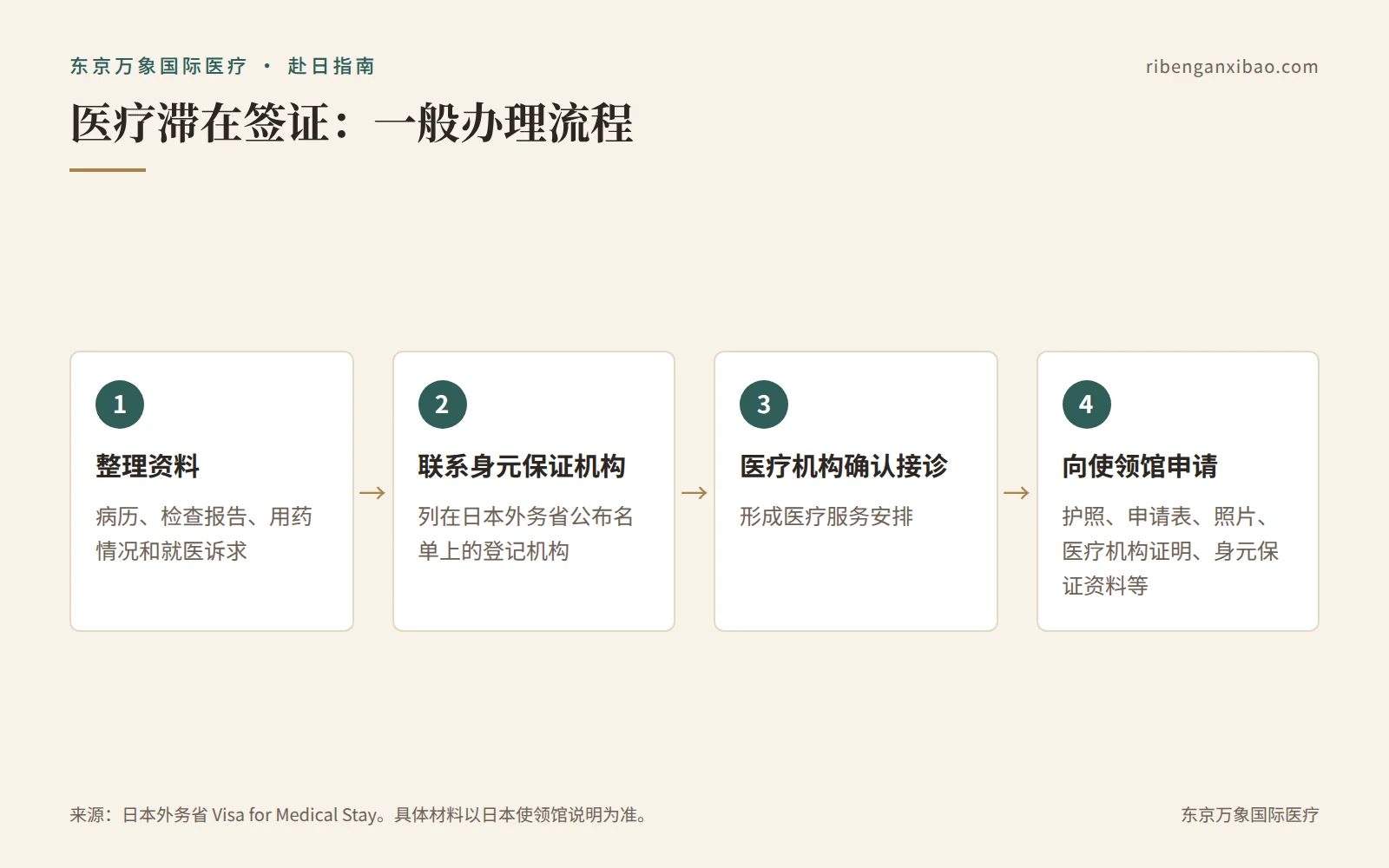
According to the process published by the Ministry of Foreign Affairs of Japan, applicants usually first contact a guarantor organization registered under the Visa for Medical Stay system, which helps contact Japanese medical institutions and arrange medical services.
This can generally be divided into four steps: first, organize medical records, test reports, current medications, and your care goals; second, contact suitable Japanese medical institutions through a guarantor organization; third, have the medical institution confirm acceptance and prepare the medical service arrangements; fourth, prepare the documents needed for the visa application: certification from the medical institution, guarantor documents, and personal documents.
Basic documents listed by the Ministry of Foreign Affairs include a passport, visa application form, photo, proof of medical arrangements issued by the medical institution and guarantor documents, and proof of financial ability. Required documents may vary by nationality, place of residence, and case; confirm with the Japanese embassy or consulate.
05
What should you check when choosing a coordination service?
A guarantor organization handles care coordination, document preparation, and related guarantees; it does not replace doctors in making diagnoses and cannot promise treatment results.
When inquiring, confirm: whether it is a registered organization listed by the Ministry of Foreign Affairs of Japan; whether service fees, translation fees, guarantee fees, and medical fees are itemized; whether medical fees are formally stated by the Japanese medical institution; whether rules on document translation, appointment changes, and refunds are clear; who will coordinate rescheduling, additional examinations, or hospitalization; and how follow-up records will be handed over after you return.
Be cautious about claims such as “guaranteed visa approval,” “guaranteed acceptance,” or “guaranteed efficacy.” Visas are reviewed by the relevant authorities, and medical institutions must independently decide whether to accept a case based on the materials.
06
Documents to prepare before traveling to Japan
To reduce back-and-forth, prepare recent test reports and imaging, existing diagnoses and treatment history, current medications and allergy history, past surgeries and significant underlying conditions, your key questions, the dates you can visit Japan and expected length of stay, and whether you need an accompanying person, interpretation, or accessibility support.
The clearer your documents, the easier it is for the medical institution to determine whether it can accept you and whether preliminary tests are needed. A safer sequence is to first organize your documents, confirm the likelihood of acceptance and the expected process, and then prepare the visa based on official documents from the medical institution and the guarantor organization.
07
References
Ministry of Foreign Affairs of Japan: Visa for Medical Stay. This article is based on the public page retrieved on June 11, 2026. Specific application conditions and documents may change; please refer to the latest guidance from the Ministry of Foreign Affairs of Japan and Japanese embassies and consulates.
08
Common questions
If I’m coming to Japan for stem cell treatment, do I have to get a Visa for Medical Stay?
It depends on nationality, length of stay, and care arrangements. For treatment purposes that require multiple trips or a longer stay, the Visa for Medical Stay is generally considered; please confirm with the guarantor organization and the Japanese embassy or consulate.
What is a guarantor organization?
It is a registered organization listed by the Ministry of Foreign Affairs of Japan that is responsible for coordinating medical institutions, preparing documents, and related guarantees. It does not diagnose in place of doctors and cannot promise results.
Can you guarantee the visa will be approved?
No. Visas are reviewed by Japanese embassies and consulates. Any claim to “guarantee approval” should be treated with caution.

