

In this article
Short answer
When taking family to Japan for medical care, prepare around four things: 1) Stabilize health first, bring enough chronic medications, and prepare a medication list stating names and doses; 2) Leave slack in the itinerary—do not pack exams, treatment, and sightseeing all in; 3) Define companion roles—one handles documents and checks translations, one handles daily needs and transport; 4) Before departure, talk through the purpose, risks, costs, and “what if we decide not to go ahead?” with your family.
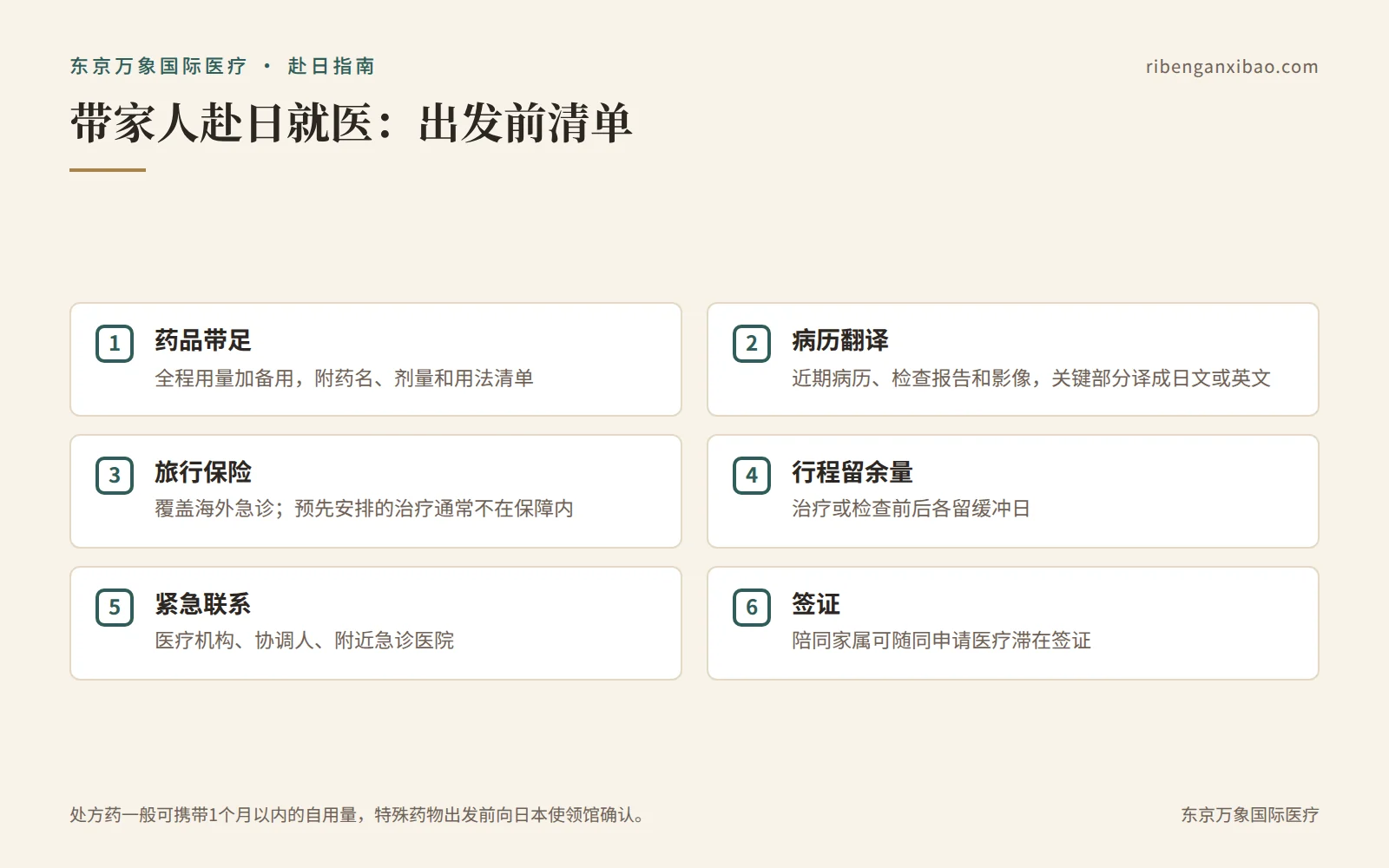
- Medications
- Bring enough for the entire stay plus spares, with a medication list (name, dose, usage). Prescription drugs can generally be carried in quantities for personal use within 1 month; more than that requires prior import confirmation.
- Medical records
- Recent medical records, test reports, and imaging; translate key parts into Japanese or English.
- Insurance
- Buy travel insurance that covers overseas emergencies; prearranged treatments are usually not covered.
- Itinerary
- Leave buffer days before and after treatment or tests. Follow the doctor’s instructions on when you can fly after treatment.
- Emergency contacts
- Phone numbers for the medical institution and coordinator, and the emergency hospital near your lodging.
- Visa
- Accompanying family members can apply together for a Visa for Medical Stay; see the visa guide for details.
01
Before departure, get your health stable first
For elderly cross-border care, the top priority is stable chronic conditions and uninterrupted medication, not stacking as many self-pay items as possible into one trip. For hypertension, diabetes, heart disease, etc., ask your doctor at home to assess whether long-haul flying is suitable before departure.
Drugs containing narcotic or stimulant components have special entry rules in Japan. Confirm with a Japanese embassy/consulate or the Ministry of Health, Labour and Welfare (MHLW) before departure.
02
How to plan the itinerary
If you are busy with limited time, prepare more in advance: send materials to the institution ahead of time, confirm the consultation time early, and leave time for follow-up. Do not schedule checkups, treatment, and sightseeing on the same day, and do not book your return flight on the treatment day.
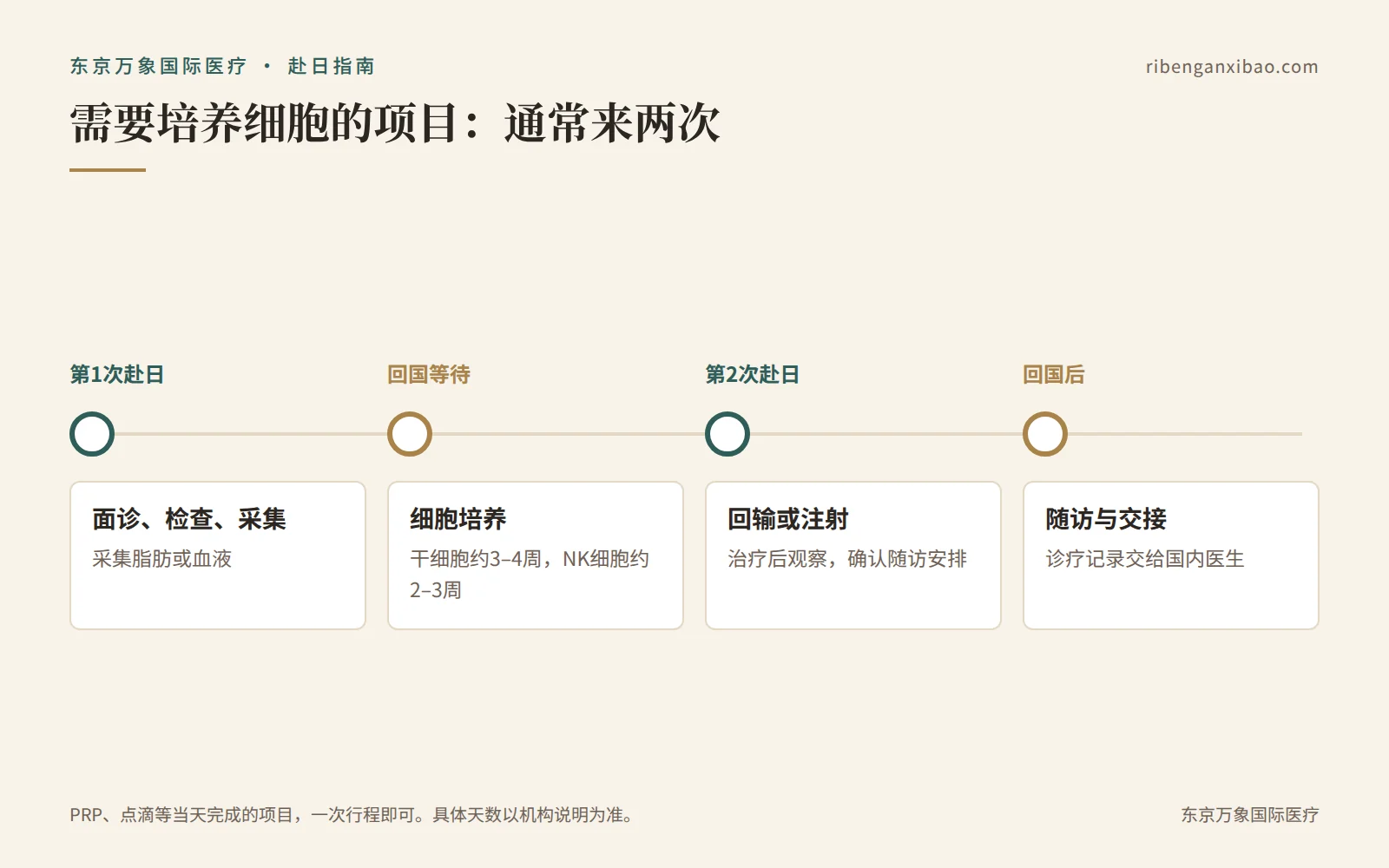
Items like stem cells that require culture usually need two visits, about 3–4 weeks apart. PRP and IV drips can be done in one visit. See the service process page’s comparison table for the exact length of stay.
03
What companions should do
It’s best for companions to divide roles in advance:
- Documents and translation: bring complete medical records and the medication list, confirm translation accuracy during the consultation, and record the doctor’s explanations.
- Daily needs and transport: lodging, transportation, meals, and schedule; watch for changes in health status.
- Emergency contacts: save the institution’s and coordinator’s phone numbers, and know where the nearest emergency hospital is.
- Respect the patient: the condition and decisions belong to the patient. Companions assist but do not decide on their behalf, and should also protect privacy.
04
When family members don’t understand: how to talk it through
Hiding the trip, or showing family only promotional materials, is not helpful for joint decision-making. A better way is to explain five things: why go (goal), what it is based on (doctor’s assessment and data), what the risks are, roughly how the costs are composed, and what happens if we don’t want to continue midway.
If you can explain these clearly, it also tests whether the decision is mature.
05
Handover after returning home
Before leaving Japan, obtain Japanese or English medical records, medication instructions, and a follow-up plan. Once home, give them to your local doctor so information connects on both sides. Confirm follow-up timing and contacts while still in Japan.
06
Common questions
My parents are old—can they take a long-haul flight?
It depends on health status, not age itself. Before departure, ask their doctor at home to assess whether chronic conditions are stable and if flying is suitable; arrange wheelchair assistance on the flight if needed.
Do accompanying family members need a visa?
They must apply according to their nationality. Japan’s Visa for Medical Stay allows companions with genuine need to apply together; specifics are subject to the Japanese embassy/consulate’s review.
Can I bring my own prescription medicines into Japan?
In general, you may carry up to a 1-month personal-use supply; exceeding that requires prior import confirmation. Drugs containing narcotic or stimulant components have special rules—confirm with a Japanese embassy/consulate or the MHLW before departure.
I’m very busy and have only 3–4 days—how should I arrange it?
Choose items that can be completed in one visit (such as PRP, IV drips, checkups), provided materials are sent in advance and the consultation time is confirmed. Items requiring cell culture generally need two visits.