

In this article
Short answer
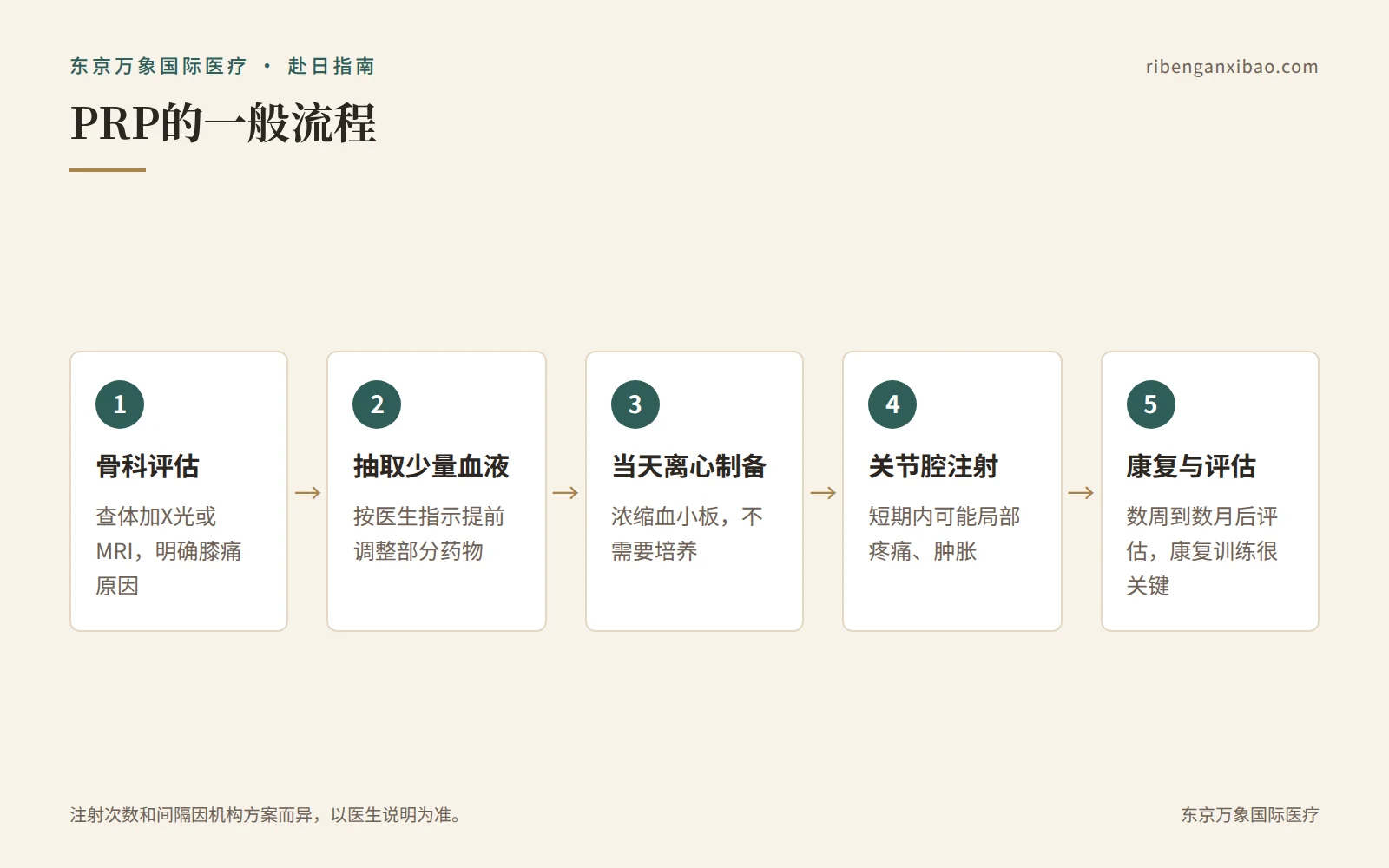
PRP (platelet-rich plasma) involves drawing a small amount of your own blood, centrifuging to concentrate the platelets, and injecting it into the knee joint. In Japan it requires a regenerative medicine provision plan registration. Research mainly focuses on pain and function improvement in mild to moderate knee osteoarthritis. Effects vary by individual, and it cannot guarantee cartilage regeneration or replace surgery. Before considering it, have an orthopedist clarify the cause of knee pain and review imaging.
- Source
- A small amount of your own blood, centrifuged and prepared the same day, no culture needed
- Management in Japan
- Requires submitting a regenerative medicine provision plan; joint indications are often registered as Class II, subject to the plan disclosed by the institution
- Common uses
- Joint pain such as knee osteoarthritis, some sports injuries
- Travel arrangement to Japan
- One trip is sufficient; allow 2–3 days (subject to the institution’s guidance)
- What it cannot promise
- Complete cartilage regeneration; guaranteed avoidance of joint replacement
- Cost
- Written quote by the institution after consultation
01
Find the cause of knee pain first
Knee pain may come from osteoarthritis (cartilage wear), meniscal injury, ligament problems, synovitis, or be related to the hip or lumbar spine. Different causes require completely different approaches.
So the first step is an orthopedic exam plus imaging (X-ray to assess joint space and osteophytes; MRI for meniscus, ligaments, and cartilage). Deciding on “PRP injections” before a clear diagnosis puts things in the wrong order.
02
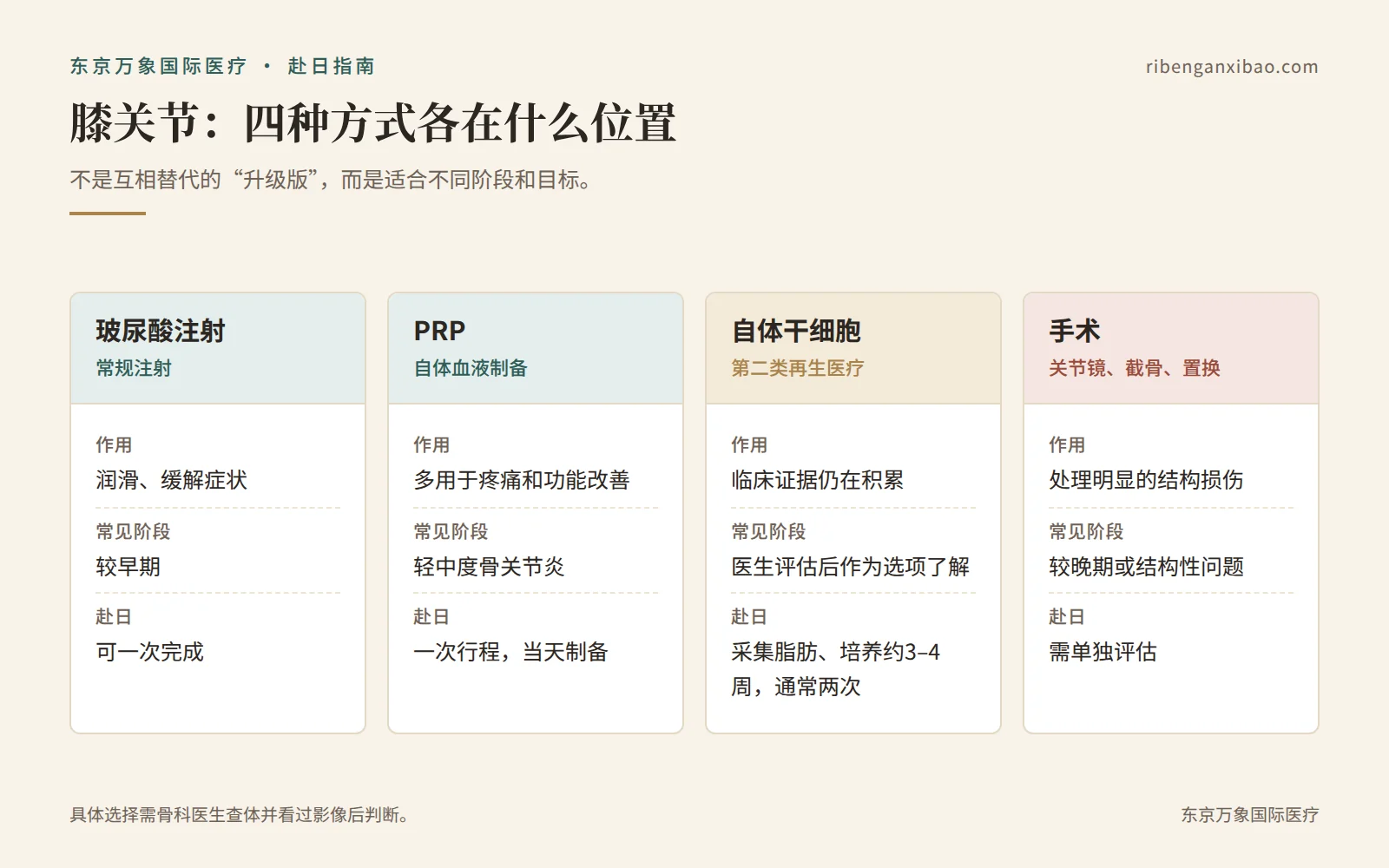
Where PRP, stem cells, hyaluronic acid, and surgery each fit
These are not “upgrades” that replace one another, but options suited to different stages and goals:
- Hyaluronic acid injections: routine intra-articular injections that mainly lubricate and relieve symptoms, suitable for earlier stages.
- PRP: prepared from your own blood, completed the same day, mostly used for pain and function improvement in mild to moderate osteoarthritis.
- Autologous fat-derived stem cells: require fat harvest and culture for about 3–4 weeks, usually needing two trips to Japan; clinical evidence is still accumulating, and it is suitable to learn about as an option after physician assessment.
- Surgery (arthroscopy, osteotomy, joint replacement): for clear structural damage or later-stage cases; do not keep postponing necessary surgical evaluation just because you prefer injections.
03
What the evidence shows so far
There is substantial research on PRP for knee osteoarthritis. Many studies report improvements in pain and function scores, but results are inconsistent and individual variability is marked. It is better viewed as part of comprehensive care, not a “no-surgery miracle.”
PRP preparation methods vary widely between institutions (platelet concentration, whether leukocytes are included, number of injections and intervals). Therefore, “PRP didn’t work for me” or “PRP worked very well” cannot be directly applied to you. Asking which preparation method is used and how outcomes are assessed is more useful than asking “does it work.”
04
What to pay attention to before and after injection
Adjust certain medications before injection as directed by your doctor (e.g., some anti-inflammatory painkillers, anticoagulants). Short-term local pain and swelling may occur after injection and usually subside gradually. Contact the institution promptly if anything unusual occurs.
Effects are usually evaluated weeks to months later. Rehabilitation during this period (strength, range of motion) greatly influences outcomes. It is best to confirm your post-return rehab plan with the doctor while in Japan.
05
When PRP is worth exploring, and when a doctor’s evaluation comes first
- Suitable to explore first: mild to moderate osteoarthritis, limited effect from conservative treatments, and you do not want or are not suitable for surgery for the time being.
- Require a doctor’s evaluation first: obvious deformity or severe joint space narrowing; joint infection; hematologic disease or current use of anticoagulants; recent intra-articular steroid injection.
06
Common questions
Can PRP make cartilage grow back?
This cannot be promised at present. PRP is more for pain relief and function improvement. Changes in cartilage structure vary by person, and consistent evidence is lacking.
How many injections are needed? How soon can effects be seen?
The number and interval depend on the institution’s protocol. Effects are generally evaluated weeks to months after injection. Follow your doctor’s specific guidance.
Can it still be done at an older age?
Age itself is not the only criterion. Key factors are the degree of joint degeneration, overall condition, and medications. A doctor needs to review your imaging to decide.
Can PRP and stem cells be done together?
Some institutions may propose combined or staged plans based on assessment, but whether this is necessary, the sequence, and the risks need to be explained by the doctor according to your situation.