

In this article
Short answer
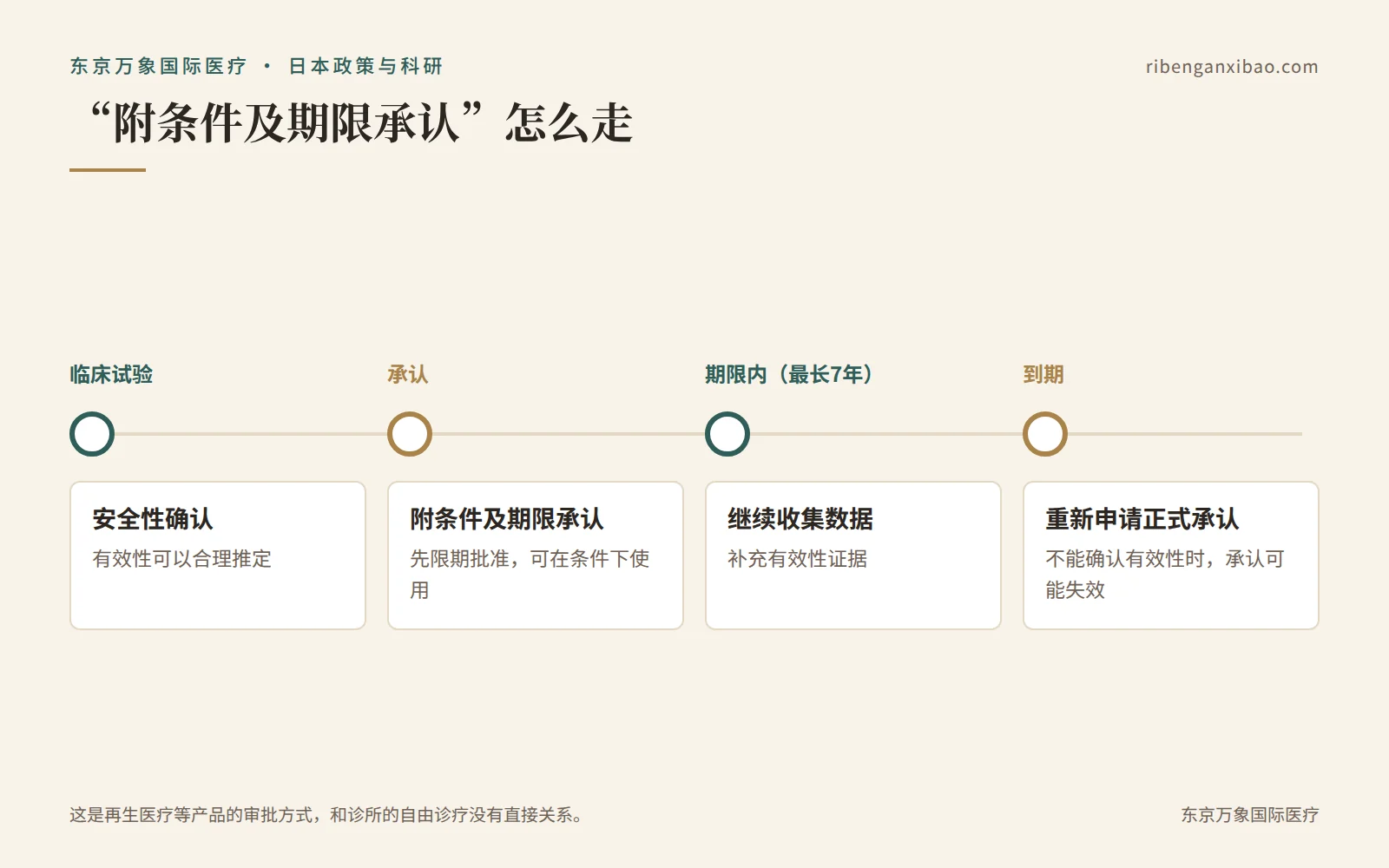
“Conditional and time-limited approval” is Japan’s approval pathway for regenerative medicine products: when safety is confirmed and effectiveness can be reasonably inferred, a conditional, time-limited approval is granted first. Data collection must continue within the term, and a new application for formal approval is made at expiry. It is not a lowering of standards, nor does it mean effectiveness has been fully proven.
- Applicable scope
- Regenerative medicine products (approval under the Pharmaceuticals and Medical Devices Act)
- Approval conditions
- Safety confirmation; effectiveness inferred
- Term
- Up to 7 years; effectiveness data must continue to be submitted during the term
- At expiry
- Reapply for formal approval; if effectiveness cannot be confirmed, the approval may lapse
- Relation to clinics’ self-pay treatments
- No direct relation; clinic treatments follow the regenerative medicine provision plan pathway
01
Overview
Recently, news about iPS cell products being approved in Japan went viral, but I noticed a problem: most Chinese-language reports only said “approved” and left out the “conditional and time-limited approval” that follows. That qualifier is the key. Bottom line first: this is not the kind of “full approval for marketing” you might imagine.
Japan’s approach is this: once safety has been confirmed to a certain extent and effectiveness can reasonably be expected, the product is allowed into clinical use first. But it is given a time limit, during which further data must be submitted, and it is re-reviewed at expiry. The Minister of Health, Labour and Welfare said clearly at the March 6, 2026 press conference: after approval, verification of effectiveness must continue.
Why make it so complicated? Because regenerative medicine products are not ordinary drugs. They are often aimed at severely ill patients with few other options, the technical bar is very high, and accumulating long-term data takes time.
If you wait to approve until all data are complete, patients cannot wait; fully opening the gate is too risky. Japan chose a middle path: open the door conditionally, but with ongoing oversight behind it. This helps you understand Japan’s regenerative medicine in two ways: first, when you see “approved” news, you can judge how solid it is.
Conditional approval ≠ unconditional maturity. Scientific breakthroughs, clinical trials, clinic marketing, and formal product approval are four entirely different tiers. Which tier a news item belongs to determines its real meaning.
Second, to judge whether an institution or treatment is reliable, see whether it sits within the regulatory framework. Treatments that withstand scrutiny always proceed along a clear, trackable, and re-evaluable regulatory pathway. If an institution throws around concepts but cannot say where its treatment sits in the system—that’s when you should think twice.
Put simply, Japan’s competitiveness in regenerative medicine is not just advanced technology; it’s also the willingness to confine “advancement” within a system, preventing it from becoming disorderly hype. Understand “conditional and time-limited approval,” and you understand the core of this logic. Sources: press conference by the Minister of Health, Labour and Welfare (2026-03-06); Science Portal (2026-03-18)
02
Common questions
For products under conditional approval, has effectiveness been proven?
Not fully proven yet. It is a limited-term approval when effectiveness can be reasonably inferred, with mandatory ongoing data collection during the term.
What happens if it fails at expiry?
If effectiveness cannot be confirmed within the term, the approval may lapse and the product can no longer be used under the original conditions.
Is this related to clinics’ stem cell treatments?
No direct relation. Clinics’ autologous stem cell treatments are provided as self-pay under regenerative medicine provision plans, not product approval.