

In this article
- 01First, check whether they assess before they treat
- 02Second, a doctor who explains the limits is more reliable than one who only talks about results
- 03Third, check registration first, then listen to the pitch
- 04Fourth, cell quality is about more than “hundreds of millions” of cells
- 05Fifth, in-house or external processing: what matters is regulatory filings and accountability
- 06Sixth, the process and follow-up matter more than the procedure itself
- 07How to read claims like “advanced” or “exclusive”
- 08Common questions
Short answer
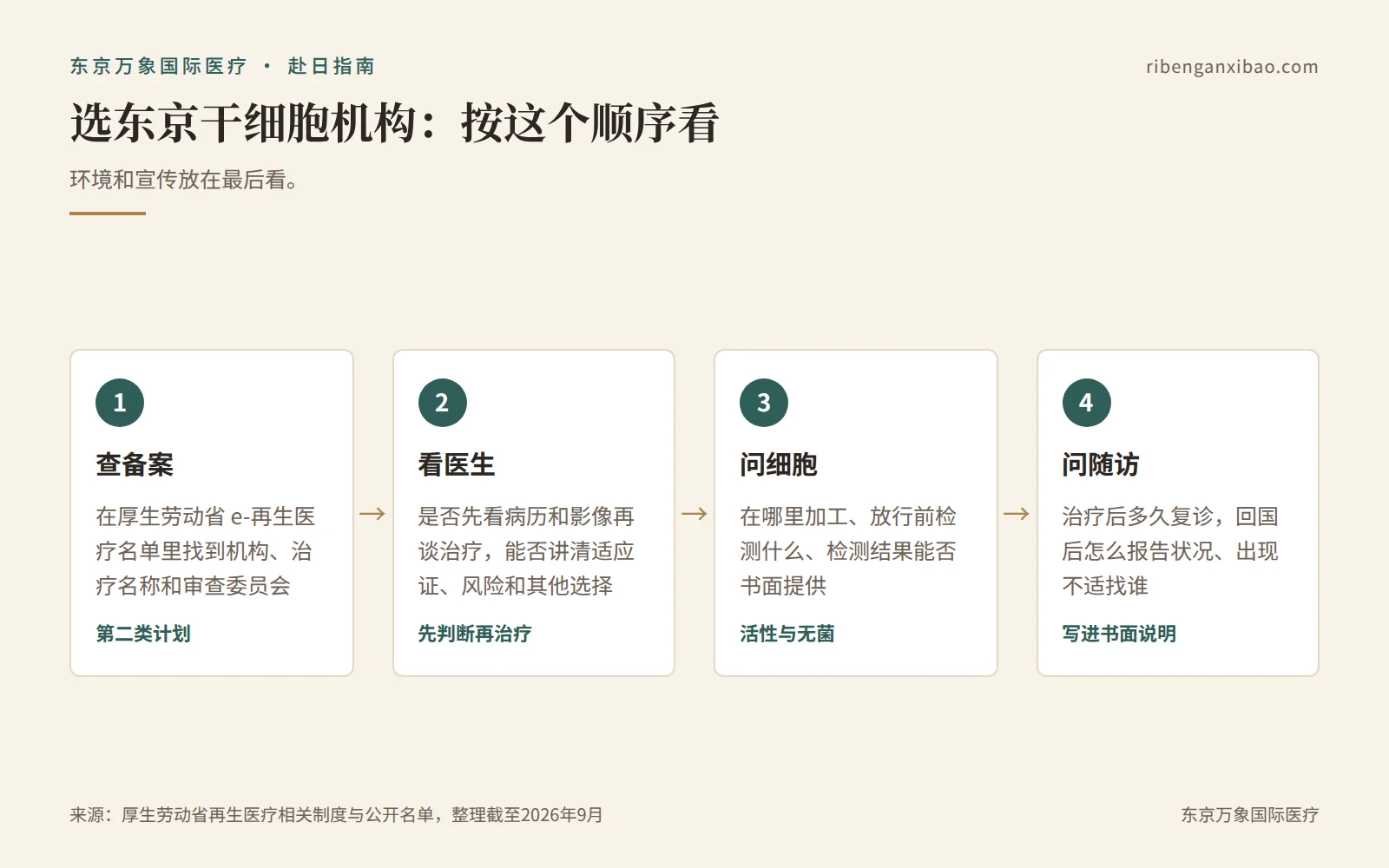
Follow this order: first, check in the MHLW’s public list whether it has the corresponding regenerative medicine provision plan; then see whether the doctor evaluates before discussing treatment and can clearly explain indications and risks; then ask where the cells are processed and whether there are test data; finally confirm who is responsible for follow-up after treatment. Look at environment and marketing last.
- Registration
- Autologous fat-derived stem cells fall under Class II regenerative medicine. Institutions must submit a provision plan, which can be found in the MHLW e-Regenerative Medicine list.
- Review committee
- Class II plans are reviewed by a “Specially Certified Committee for Regenerative Medicine,” and the list will specify which committee it is.
- Cell processing
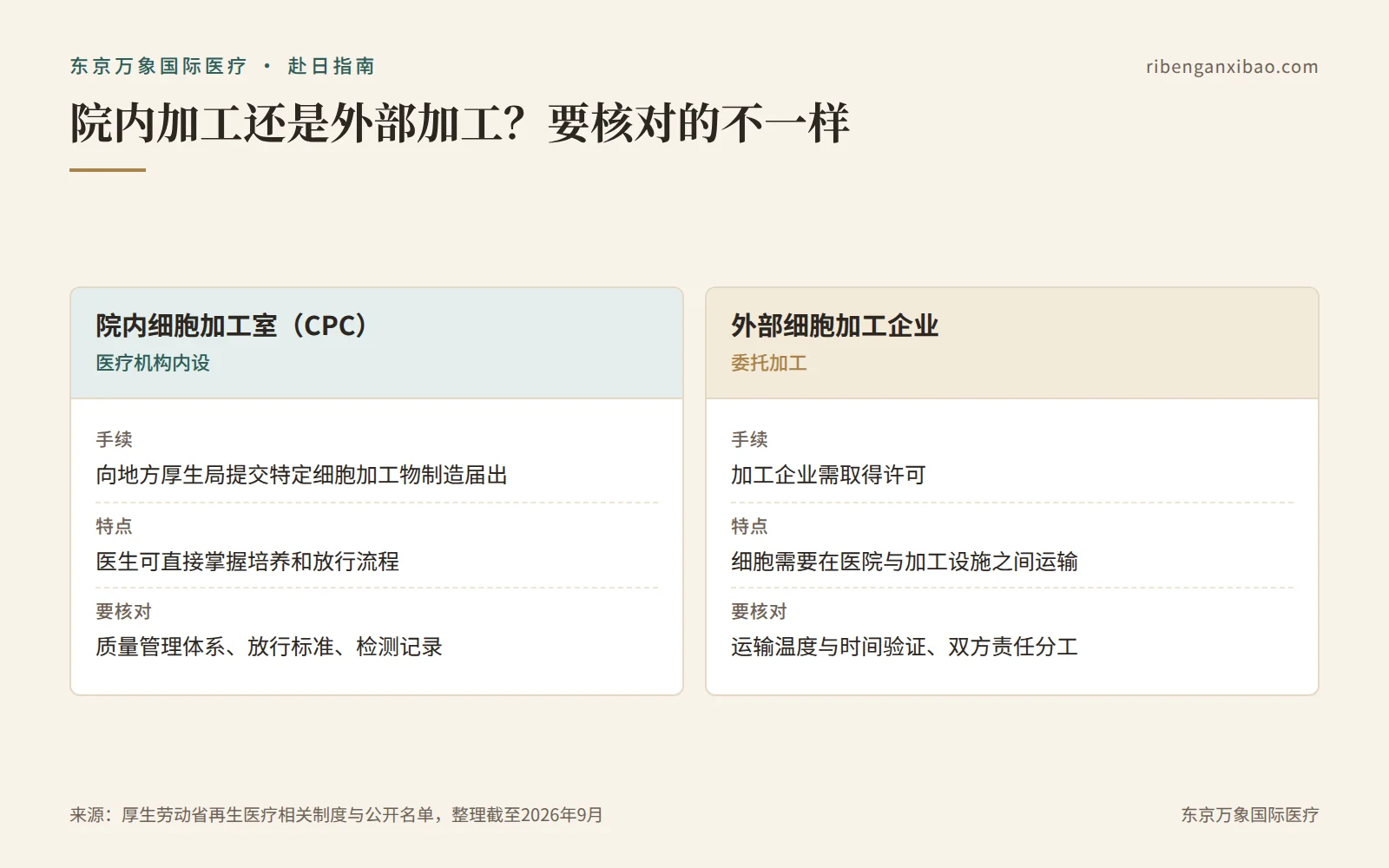
- An in-house cell processing center (CPC) must file a registration with the regional bureau of health and welfare; if outsourcing to an external company, the latter must hold a license.
- Doctors
- The responsible doctor’s specialty and experience in regenerative medicine, and whether they personally conduct the consultation and lead decision-making.
- Test data
- Beyond cell counts, whether results for viability, sterility, etc. can be provided.
- Follow-up
- How long until the next visit after treatment, how to report your status after returning home, and whom to contact if issues arise.
01
First, check whether they assess before they treat
Many people naturally start by asking which place is best, then the price, then reputation and environment. From a medical perspective, a professional institution won’t follow that sequence, because medicine must first answer “is it appropriate to do,” not “what can be done.”
Even with the same knee issue, there are different situations: early degeneration, structural injury, postoperative recovery, chronic inflammation, etc. Whether a provider pushes a package first, or is willing to review records and imaging, clarify medical history, and judge indications—this alone says a lot. True professionalism is not about fast answers, but accurate judgment.
02
Second, a doctor who explains the limits is more reliable than one who only talks about results
Stem cell treatment shows clear individual variability. Some people are suitable to consider it; some need to be more cautious. Some aim for improvement and slowing progression; some should not set overly high expectations. In some cases, stem cells shouldn’t be a priority option. These aren’t “pleasant” points, but they best reflect professionalism.
Ultimately, the key to stem cell treatment lies with the doctor: whether they understand cell culture and application, know the differences and risks among protocols, and lead key decisions throughout. During consultation, you can ask directly:
- Am I a good candidate? In which situations is it not recommended?
- What is the treatment goal, over what timeframe, and with what metrics will it be evaluated?
- What are the possible risks and adverse reactions, and how would they be managed if they occur?
- Besides stem cells, what other options are there (physical therapy, medications, PRP, surgery)?
- Is the same doctor responsible for consultation, procedures, and follow-up?
03
Third, check registration first, then listen to the pitch
In Japan, regenerative medicine isn’t something an institution can offer at will. For treatments using autologous stem cells, institutions must submit a provision plan under the Act on the Safety of Regenerative Medicine and have it reviewed by a committee; providing care without completing procedures is illegal.
Verification is simple: ask the institution for the treatment name and plan number, then find the institution in the MHLW e-Regenerative Medicine public list and confirm that the treatment name and review committee match what the institution says. See this site’s “How to check a Japanese institution’s regenerative medicine registration” for the steps. Note that registration shows it is under statutory oversight; it does not mean the government recognizes efficacy.
04
Fourth, cell quality is about more than “hundreds of millions” of cells
Numbers are the easiest to remember in conversations: how many cells, how many sessions, how long. But quantity is only one parameter; you also need to look at cell status and viability, and whether there are supporting test data.
Whether cells are used after cryopreservation or directly after culture, each has its own process requirements; this alone does not equate to “safer” or “more effective.” Worth asking: what release tests are performed, what viability standard is required, and whether results can be provided in writing.
05
Fifth, in-house or external processing: what matters is regulatory filings and accountability
Some institutions have an in-house CPC; others outsource to specialized external companies. Both approaches can operate compliantly. In-house processing lets doctors directly grasp the process; with external processing, look at how transport time and temperature are ensured.
In either case, you should verify: whether the processing facility has filed registration or obtained a license, its quality management system, transport validation, release criteria, and how responsibility is allocated between the hospital and the processor if problems occur.

06
Sixth, the process and follow-up matter more than the procedure itself
Professionalism often shows before and after treatment: whether there is a sufficient initial evaluation, complete explanations and informed consent, monitoring by doctors and nurses before and after infusion or injection, and regular follow-up after treatment.
For overseas patients, post-return follow-up is especially important: how often to report status, by what method, and whom to contact if unwell. Institutions that can explain this clearly and put it in writing are more trustworthy.
07
How to read claims like “advanced” or “exclusive”
Phrases like “hidden champion,” “cannot be replicated,” and “most advanced” are marketing judgments and cannot be verified. More reliable are things that can be found and written down: public registrations and qualifications, names and CVs of responsible doctors, quality test records, and periodic reports.
When we compare Tokyo institutions, we also prioritize information that can be verified. Take Ginza YR Clinic as an example: its Class II and Class III plans and in-house cell processing registrations can all be checked in official lists (this site has a cooperative relationship with this clinic; see “About us” for details).
08
Common questions
Do institutions offering stem cells in Tokyo have to be registered?
Yes. For regenerative medicine using autologous fat-derived stem cells, institutions must submit a provision plan under the Act on the Safety of Regenerative Medicine and have it reviewed by a committee. Providing care without completing procedures is illegal. You can directly ask the institution for the plan number and treatment name to verify.
Which is better, a university hospital or a clinic?
You can’t judge by size. They may follow different legal pathways: some conduct clinical research, others provide self-pay (non-insured) treatment. The key is still the specific treatment’s registration, the responsible doctor, and the follow-up arrangements.
Are more cells always better?
Not necessarily. Quantity is only one parameter; you also need to consider cell viability, test results, route of administration, and your specific situation. The doctor should explain this based on an assessment.
Are institutions with an in-house cell processing center (CPC) more reliable?
In-house processing helps doctors grasp the process; external processing can also be compliant. What you should verify are the processing facility’s registration or license, quality system, transport and release standards.