

In this article
Short answer
In May 2026, the Ministry of Health, Labour and Welfare (MHLW) and the Ministry of the Environment (MOE) issued corrective orders to 33 medical institutions nationwide because they used treatments involving genetically modified organisms in self-pay cancer care without legally required approval. This is not about ordinary targeted drugs, nor does it mean self-pay or regenerative medicine in Japan is unavailable. It is a reminder to confirm the treatment’s legal pathway.
01
1) What exactly was flagged this time?
There was an important piece of news in Japan’s medical field recently. The Ministry of Health, Labour and Welfare (MHLW) and the Ministry of the Environment (MOE) issued corrective orders to 33 medical institutions nationwide. The reason: in self-pay cancer care, these institutions used gene therapies involving “genetically modified organisms” without obtaining the legally required approval.
Many people may think: Are targeted drugs in Japan being scrutinized? Is self-pay cancer care no longer possible? Is there a problem with regenerative medicine in Japan? It’s important to distinguish these issues.
This time, what was flagged is not ordinary targeted drugs.
02
2) How do ordinary targeted drugs differ from this incident?
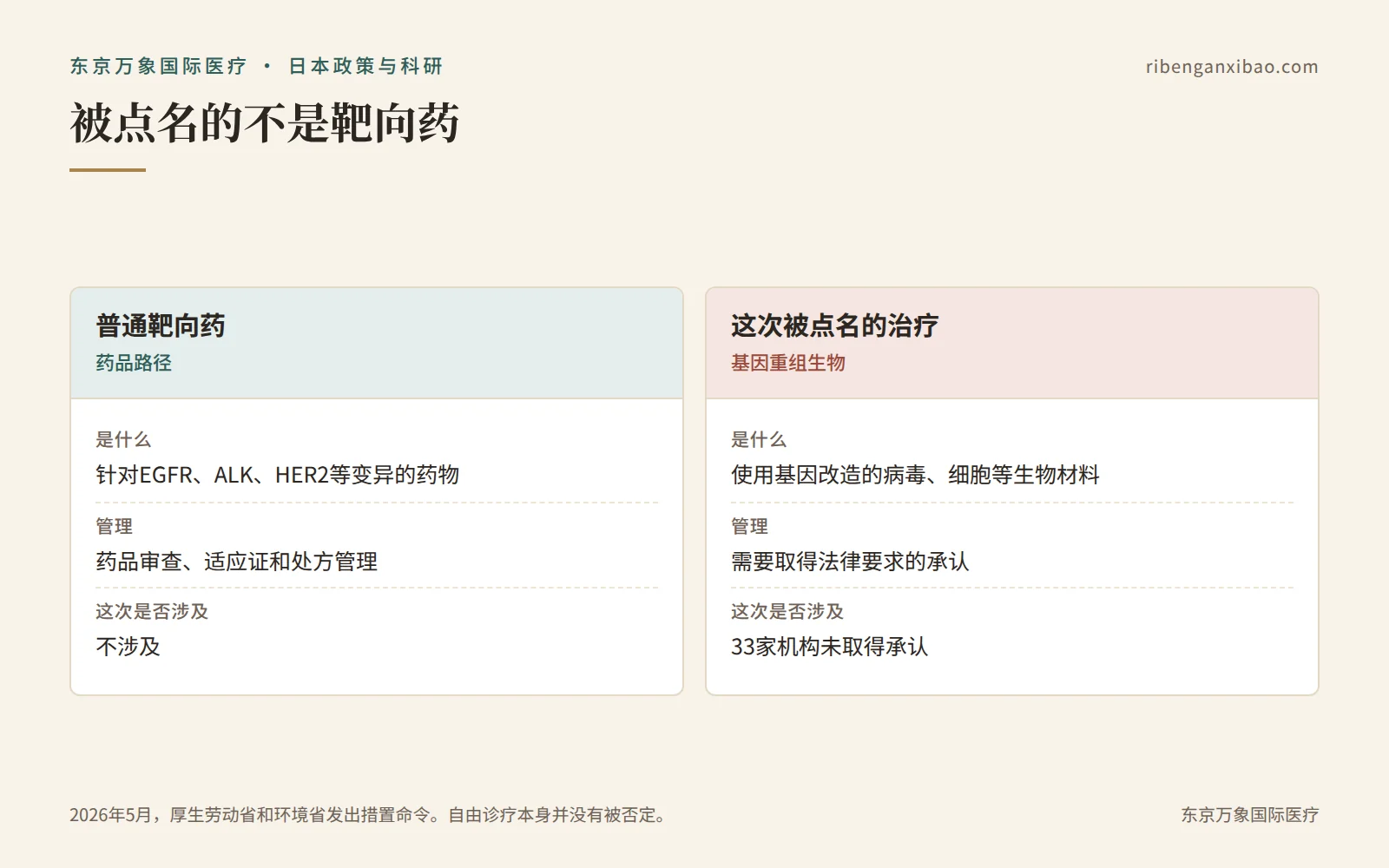
Ordinary targeted drugs—such as treatments targeting EGFR, ALK, HER2, BRAF, PARP mutations—are, in essence, therapies that already follow a clear drug pathway. They usually concern drug review, indications, prescribing, and clinical management.
But the focus of this news is another type of treatment: using gene-modified viruses, cells, or related biological materials in humans. If “genetically modified organisms” are involved, Japan may impose stricter legal and environmental safety management requirements.
Simply put, the issue is not the words “cancer treatment,” nor just “gene,” but whether the necessary approvals and procedures under Japanese law were obtained.
03
3) Does this mean self-pay treatment in Japan is unavailable?
That is not the right interpretation.
Self-pay (non-insured) treatment in Japan itself has not been rejected. Japan permits certain self-pay services, including tests, treatments, anti-aging, regenerative medicine, and immune cell therapies that are not covered by public insurance. But self-pay does not mean bypassing all rules.
The more a treatment involves cell handling, gene manipulation, viral vectors, regenerative medicine, or immunotherapy and other complex techniques, the more you must confirm which compliance pathway it follows.
04
4) What should patients coming to Japan focus on?
First, confirm exactly what the treatment is. Do not stop at big terms like “gene therapy,” “immunotherapy,” or “regenerative medicine.” Clarify whether what is used is a drug, cells, a viral vector, or other biological materials.
Second, confirm whether the medical institution has the relevant notifications, plan numbers, review materials, or legally required approvals. For regenerative medicine in particular, confirm compliance with the Act on the Safety of Regenerative Medicine.
Third, confirm whether the physician can clearly explain risks, including fever, infection, allergy, immune reactions, tumor-related risks, prior history limits, and post-treatment monitoring.
Fourth, be wary of overpromotion. If a treatment is packaged as “no side effects,” “100% effective,” “cures cancer,” or “replaces all standard treatments,” be very cautious.
05
5) Our takeaways
These 33 institutions being named does not mean Japanese healthcare is unreliable. It shows that regulation in Japan is tightening and that gray areas in self-pay treatment are being addressed more clearly.
For clients who truly need treatment or consultation in Japan, the key is not to be frightened by headlines, but to judge: Is it clear what the treatment involves? Is the pathway legal? Does the doctor provide sufficient explanations? Does the institution have the proper qualifications? Is the treatment appropriate for your disease stage?
Seeking medical care in Japan is not simply chasing “new technology.” It is about balancing safety, compliance, medical judgment, and real benefit.
06
Common questions
Is this incident related to targeted drugs?
No. What was flagged were treatments using gene-modified viruses, cells, and other biological materials, not targeted drugs used through a drug pathway.
Is self-pay treatment in Japan still available?
Yes. Self-pay itself has not been rejected, but treatments involving cells, genes, or viral vectors must follow the corresponding legal procedures.
How can I avoid treatments like these?
Clarify whether the treatment uses a drug, cells, viral vectors, or other materials; ask for the relevant plan number or approval documents; and have the physician personally explain the risks.