
In this article
Short answer
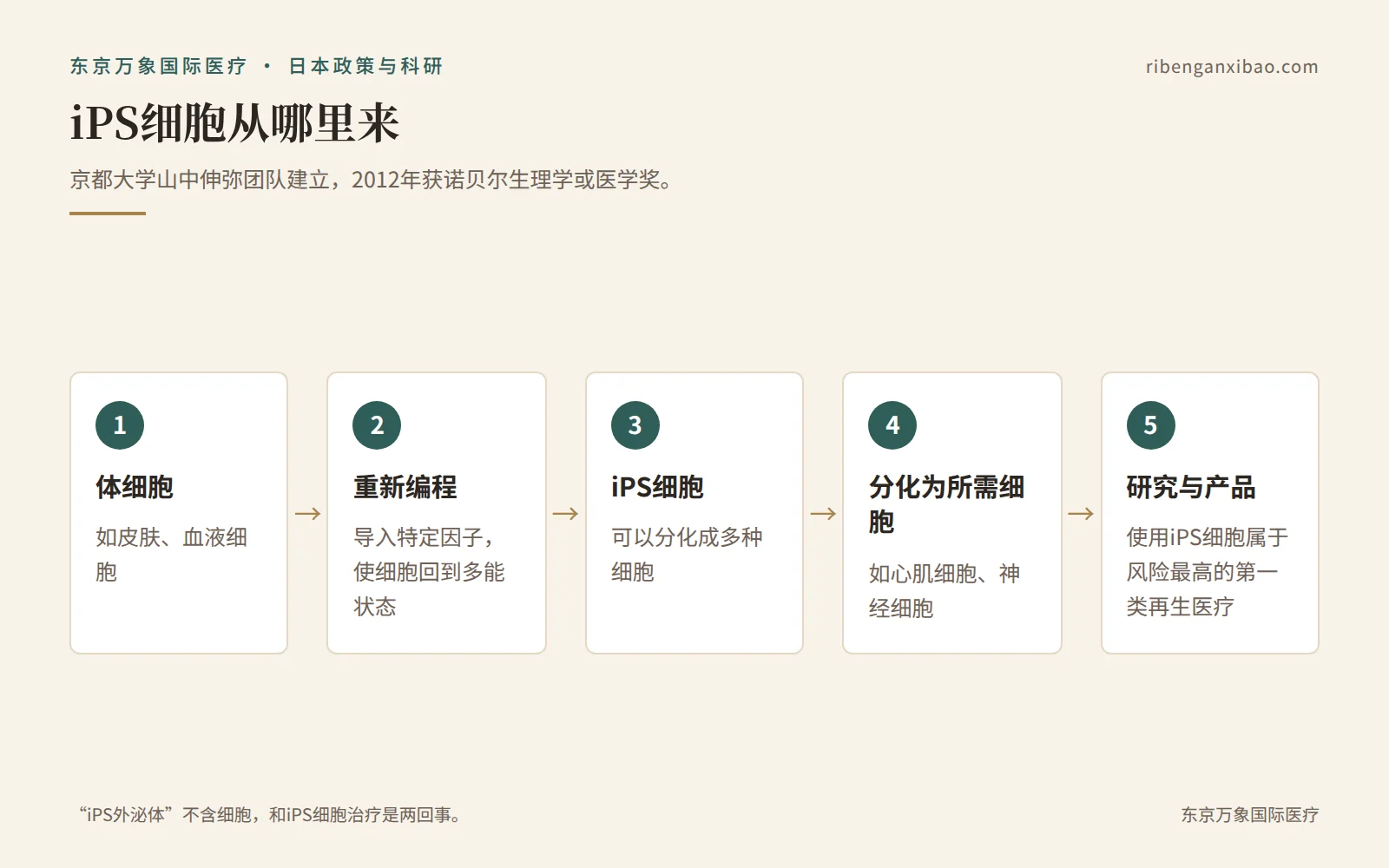
iPS cells (induced pluripotent stem cells) are stem cells obtained by “reprogramming” somatic cells such as skin and blood cells, and can differentiate into multiple cell types. They were established by Dr. Shinya Yamanaka’s team at Kyoto University, work that won the Nobel Prize in 2012, and Japan has long invested heavily in this area. Treatments using iPS cells in Japan fall under Class I regenerative medicine, the highest-risk category, with a high bar; “iPS exosomes” do not contain cells and are a different matter.
01
Overview
If there is a single most representative keyword in Japan’s regenerative medicine, many people first think of iPS cells. It has long drawn attention not only because it is closely tied to Japan’s scientific achievements, but also because, in the public narrative of regenerative medicine, it has almost become synonymous with “cutting-edge technology.”
The full name of iPS cells is commonly translated as “induced pluripotent stem cells.” Simply put, they are pluripotent cells obtained by “reprogramming” mature somatic cells using specific methods. Public sources show that this line of work was first reported in 2006 by the team of Dr. Shinya Yamanaka at Kyoto University, and it soon became a major topic in regenerative medicine research worldwide. Japan’s particular emphasis on iPS cells is closely related to this head-start advantage.
So, why are iPS cells important? The core reason is that they are thought to have the potential to offer new tools and pathways for tissue repair, disease research, drug development, and cell therapy. For regenerative medicine, this means it is not just a laboratory concept but may gradually move toward stages closer to practical application. In March 2026, two regenerative medicine products using iPS cells received conditional and time-limited approval in Japan, further heightening public attention to this direction.
However, when understanding iPS cells, note this: their importance does not mean all related technologies are already mature or uniform. iPS cells are more like a platform technology or core direction than a single product term. Work around them spans basic research, disease models, drug screening, and the development of regenerative medicine products for specific indications. Maturity differs greatly across these layers and should not be conflated.
In Japan’s regenerative medicine context, another practical reason iPS cells draw attention is that they carry the social expectation of “turning scientific achievements into real medical value.” In the past, the public associated iPS cells more with universities, research institutes, and award-winning results; now, as information about product approvals, academic society meetings, and PMDA public events increases, iPS cells are appearing more often in discussions of development, review, and clinical application.
This is also why whenever major news breaks in Japan’s regenerative medicine, iPS-related topics quickly become the focus. They bear a strong research label and also offer room to imagine real-world use. From a communications perspective, they naturally combine “technology frontier + Japanese characteristics + a sense of medicine’s future.”
But for general readers, the key is not just to remember that “iPS is advanced,” but to understand that iPS cells represent a direction that is continuously moving forward. Their value lies in steadily expanding the boundaries of regenerative medicine, not in making people think all related projects are already ready-made, standardized, mature solutions.
So why are iPS cells so closely watched in Japan’s regenerative medicine? The answer can be summed up in three points: they have a distinctly Japanese research background, they have high technical potential, and they are gradually moving from research toward products and applications. Grasping these three points explains why they consistently sit at the center of Japan’s regenerative medicine news.
02
Common questions
Can clinics provide iPS cell treatments?
Using iPS cells falls under Class I regenerative medicine with the highest review threshold. At present it mainly occurs within the frameworks of clinical research and approved products, and is not commonly found as self-pay (non-insured) treatment at ordinary clinics.
Are “iPS exosomes” the same as iPS cell therapy?
No. Exosomes are vesicles secreted by cells and do not contain cells; exosomes derived from iPS cells had not, as of September 2026, been brought under management by the Act on the Safety of Regenerative Medicine.