

In this article
Short answer
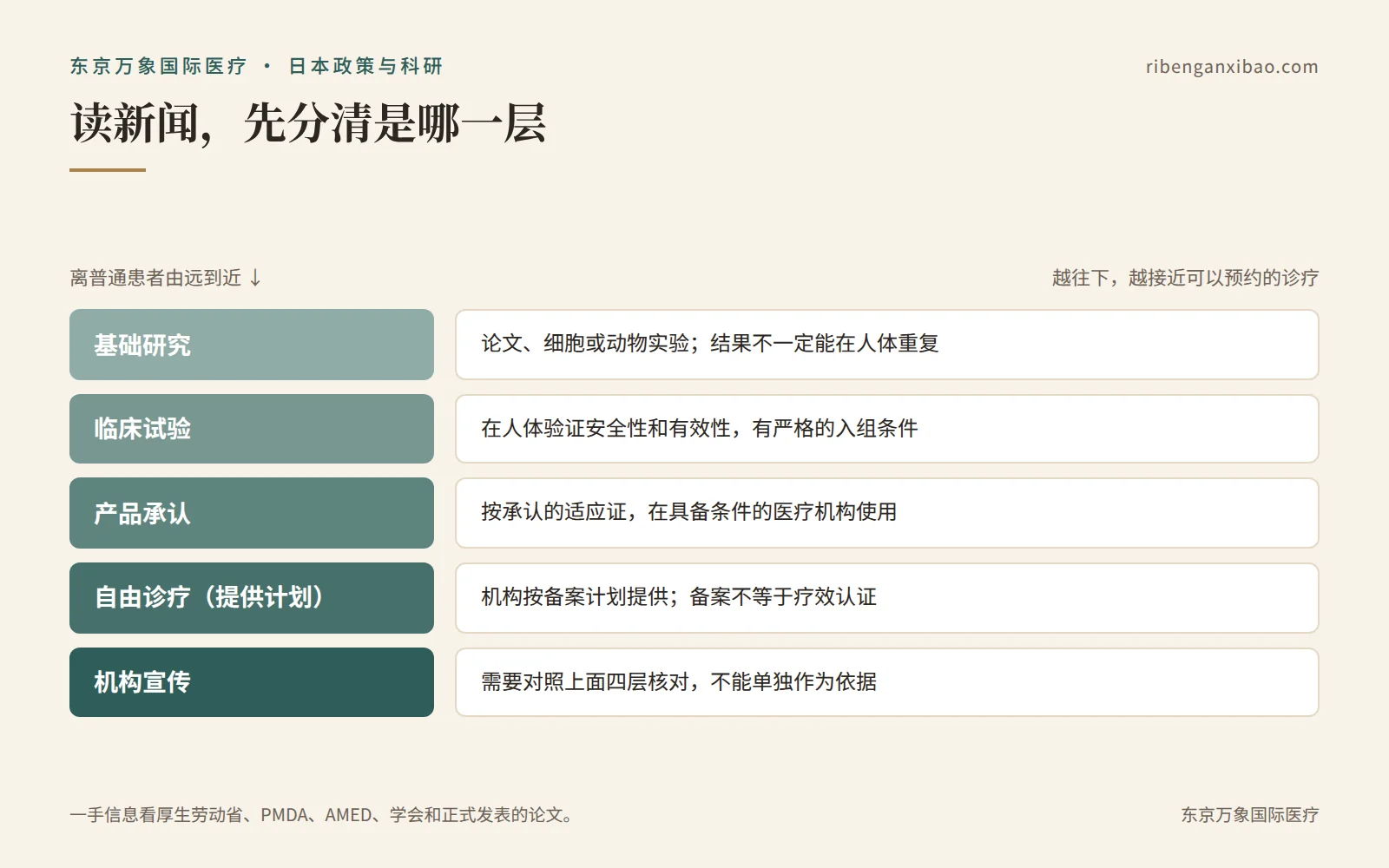
When reading Japan’s regenerative medicine news, first decide which level it is: basic research (papers, animal studies), clinical trials, product approval (under the Pharmaceuticals and Medical Devices Act), self-pay treatment provided under a provision plan, or institutional promotion. Different levels are at very different distances from “available to ordinary patients.” Then check which disease it targets, what cells are used, and what stage it is at, and you won’t be led by the headline.
- Basic research
- Papers, cell or animal experiments; farthest from patients, and results may not reproduce in humans
- Clinical trials
- Safety and efficacy tested in humans; strict enrollment criteria; outcomes uncertain
- Product approval
- Used in qualified medical institutions according to the approved indications
- Self-pay treatment (provision plan)
- Provided by institutions according to a registered plan; registration means entry into legal oversight, not proof of efficacy
- Institutional promotion
- Must be cross-checked against the first four levels; cannot stand alone as evidence
01
Start by telling the five levels apart
Research breakthroughs, clinical trials, product approvals, treatment offerings, and promotion represent entirely different stages and responsibilities. Which level a news item belongs to determines how meaningful it is for you.
A common misreading is to map upstream progress directly downstream: seeing a paper and assuming clinics can already do it; seeing a product approved and assuming all related offerings are mature.
02
Treatments for the same disease can be at different stages
Take Parkinson’s disease and heart disease as examples: even within “cell therapy,” some already have products with conditional approval, some are still in clinical trials, and some are only at the animal study stage. Cell sources (iPS, ES, autologous, from others), administration methods, and target populations also differ.
So when you read the news, get specific: which disease, which cells, which stage, and which patients.
03
Ask four questions when reading the news
- Which level is it: research, trial, approval, treatment, or promotion?
- Which disease does it target, and which patients is it for?
- What cells are used, and where do they come from?
- Who released it: government, a review agency, an academic society, a journal, or the institution itself?
04
Be especially careful with these claims
- “Japan’s stem cell treatments fully approved”: this is false; approvals are for specific products and indications.
- “Cure,” “no surgery,” “reverse”: clinical news rarely supports such conclusions.
- “Not available in mainland China, already available in Japan”: first confirm whether it’s research, an approval, or self-pay treatment.
05
Where to find primary information
The Ministry of Health, Labour and Welfare (MHLW; regulatory framework and provision plans), PMDA (product reviews), AMED (research funding and public events), the Japanese Society for Regenerative Medicine, and formally published journal papers. Information traceable to these sources is far more reliable than secondhand summaries.
06
Common questions
The news says there’s a new stem cell breakthrough in Japan. Can I get it?
First confirm its level. If it’s only research or a clinical trial, it generally can’t be booked as a treatment; offerings at clinics depend on their own registered provision plans.
Can I enroll in a clinical trial in Japan?
Most clinical studies in Japan are posted on jRCT. Enrollment criteria are strict, and eligibility for foreign patients varies by trial and is usually limited. You can ask a doctor to help assess if there is a suitable trial.