
In this article
Short answer
There are three main lines in Japan’s regenerative medicine in 2026: first, high-barrier projects are accelerating clinical translation, with iPS cell products receiving conditional and time-limited approval for the first time; second, regulation is refined in parallel, with the Ministry of Health, Labour and Welfare (MHLW) and the review agency, the Pharmaceuticals and Medical Devices Agency (PMDA), placing greater emphasis on development pathways and information disclosure; third, research is moving from single cells to complex tissues such as organoids, mainly serving efficacy prediction and drug screening. For patients, the more cutting-edge the technology, the more you need to return to systems and evidence to judge it.
- Product translation
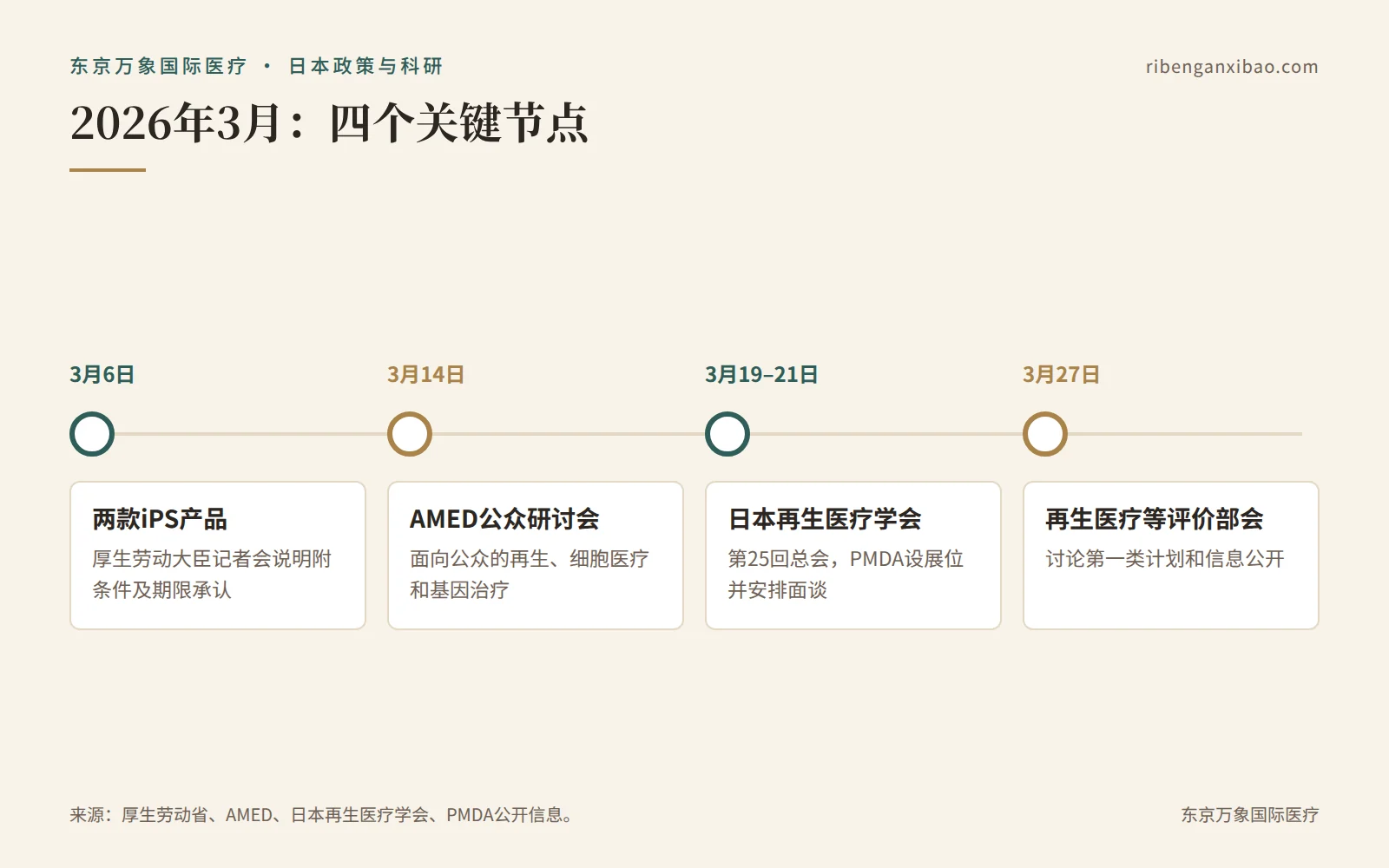
- In March 2026, two iPS cell products received conditional and time-limited approval
- Regulation
- The Health Sciences Council’s Subcommittee on Evaluation of Regenerative Medicine, etc. (March 27, 2026) continued to discuss Class I provision plans and information disclosure
- Industry
- The 25th Annual Meeting of the Japanese Society for Regenerative Medicine (March 19–21, 2026): the Pharmaceuticals and Medical Devices Agency (PMDA) set up a booth and arranged one-on-one meetings
- Public communication
- On March 14, 2026, the Japan Agency for Medical Research and Development (AMED) held a public seminar on regenerative and cellular medicine and gene therapy
- Cutting-edge research
- Kyoto University and others are advancing organoid research, currently mainly for efficacy prediction and drug screening, and not yet therapeutic products
01
Track 1: From research to products
Approval of iPS products is the clearest signal: Japan has made a substantive breakthrough on the “bench-to-bedside” path. This is not just an academic achievement; it is the result of institutional design, industrial uptake, and clinical validation running in step.
02
Track 2: Regulatory refinement in parallel
A technological breakthrough does not mean looser regulation. In March 2026, the Health Sciences Council’s Subcommittee on Evaluation of Regenerative Medicine, etc. was still discussing Class I provision plans and information disclosure. In plain terms: the oversight is getting more detailed, not looser.
Another signal is “front-loaded communication”: the Pharmaceuticals and Medical Devices Agency (PMDA) set up a booth during the meeting and arranged one-on-one meetings, indicating that development pathways, dossier preparation, and communication with the review agency have already become a key link to entering the medical system.
03
Track 3: From insider topic to public issue
In March, the Japan Agency for Medical Research and Development (AMED) held a seminar for the general public, and the 25th Annual Meeting of the Japanese Society for Regenerative Medicine also set up an international conference specifically on iPS. Japan is consciously moving regenerative medicine from a topic among researchers to a real issue the public can join in discussing.
04
A word to remember after iPS: organoids
Organoids are miniature three-dimensional tissues grown from stem cells in vitro that can mimic some functions of organs. They are not complete organs, but are closer to the human environment than cells grown in two-dimensional culture.
Their near-term value is mainly in three areas: predicting treatment effects in vitro using a patient’s own cells, screening drugs more realistically, and providing tools for personalized medicine. There is still a long way from academic forums to clinical application; they are more like a foundational capability to make treatment more precise, rather than a product that directly treats disease.
05
What this means for people considering coming to Japan
The competitiveness of regenerative medicine in Japan does not lie in whether any single technology is “number one in the world,” but in whether research, industrialization, regulation, and clinical practice can be placed within the same framework. For patients, this means: the more cutting-edge something is, the more you should ask which tier it sits in, whether it has been registered with the MHLW, and how far the evidence has progressed.
06
Common questions
Can organoids be used to treat disease?
At present they are mainly used for research, drug screening, and efficacy prediction, and are not a treatment you can book yet.
Will regulatory refinement affect current self-pay treatments?
Regulatory refinement mainly raises thresholds and transparency; treatments provided in compliance with their provision plans need to keep meeting the requirements. Specific changes are subject to announcements by the Ministry of Health, Labour and Welfare (MHLW).